

Six Girl Groups in 25 Days. K-Pop's Busiest May Is Not a Coincidence.


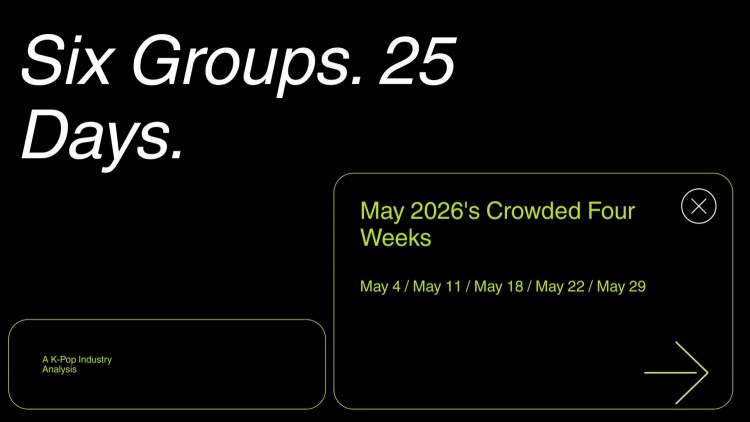
Between May 4 and May 29, six of K-pop's most commercially significant girl group acts will release new music within 25 days of one another. BABYMONSTER on May 4. NMIXX on May 11. ITZY and I.O.I on May 18 and 19 respectively. LE SSERAFIM on May 22. aespa on May 29. The month also includes solo comebacks from BIGBANG's Taeyang and NCT's Taeyong, a re-debut from ZEROBASEONE, and a reunion project from the original Produce 101 cast. By any measure, this is the most concentrated release window in K-pop's 4th-generation era.
The industry explanation is simple: every major label is publishing its biggest assets at the same time. The structural explanation is more interesting.
For four years - from BTS's October 2022 announcement of military enlistment through the last member's discharge in mid-2025 - the group that had functioned as K-pop's gravitational center was absent from the group release calendar. During that period, their label HYBE reported an 18.8% year-over-year drop in recorded music revenues in Q3 2024 alone. The broader Korean market felt it: Circle Chart data shows that roughly 93 million albums were sold in South Korea in 2024, down 23 million from the previous year. The number of domestic acts clearing 3 million in annual album sales fell from 11 in 2023 to seven in 2024.
That contraction didn't mean fans stopped caring. It meant pent-up demand accumulated inside a system that had nowhere to discharge it. When BTS's Arirang arrived in March 2026, debuting at No. 1 on the Billboard 200 with 641,000 album units in its first week, and the subsequent world tour sold out 41 stadium dates across North America and Europe within hours of going on sale, the industry got its answer. The hiatus had not eroded the market. It had compressed it.
What's happening in May is label after label reading the same data and reaching the same conclusion: BTS's return has unlocked consumer spending that accumulated over four dormant years, and the window to capture it is now. YG scheduled BABYMONSTER's CHOOM and a five-continent world tour. Source Music positioned LE SSERAFIM's second full album, Pureflow pt. 1, as a comeback three years in the making. SM loaded both aespa's LEMONADE and Taeyong's first solo LP into the same four-week stretch. JYP put ITZY and NMIXX back-to-back. The reasoning at each label is structurally identical: a BTS comeback concert drew 18 million Netflix viewers in March, and tour searches spiked hotel bookings in every stop city by thousands of percent. The audience is activated. The question is who captures it.
This is not a Taylor Swift problem. The Eras Tour created an attention singularity - every other arena act spent 2023 and 2024 routing around it. K-pop in May 2026 works differently: the acts are competing for a shared fanbase with overlapping but not identical spending patterns, and physical album sales in particular function more like collectibles than records. A devoted fan of aespa and LE SSERAFIM will likely buy both. The casualty of this compressed schedule isn't individual sales - BABYMONSTER broke its first-day record despite the crowded field - it's media bandwidth. When six major acts compete for the same editorial and playlist real estate inside a single month, the ones without a distinctive narrative angle get flattened.
I.O.I has the strongest non-algorithmic hook in May's slate. The project girl group, formed on Mnet's Produce 101 in 2016 and disbanded in 2017, is releasing its third mini album I.O.I: LOOP to mark the group's tenth anniversary, with Jeon So-mi credited as a lyricist on the title track. In a month built around YG, SM, JYP, and HYBE commercial logic, a nostalgia project where the cast has gone on to solo careers across multiple labels operates by different physics. It can't be outspent. It can only be outrated.
What the May 2026 release calendar makes visible is that K-pop's major labels made strategic decisions during BTS's absence based on a specific belief: that the fandom's spending capacity had not shrunk, it had simply been waiting. BABYMONSTER's 387,871 first-day physical sales - a group record - and BTS's sellout of 41 stadium dates support that reading. The calculation may prove correct for the top of the market. Whether it leaves the middle tier, the NMIXX and ITZY tier, with enough oxygen to build durable careers is a different question, and May 2026 is the first real stress test.
The competitive logic of May 2026 also reveals something about how K-pop's mid-tier labels have adjusted to operating in the shadow of HYBE. SM, JYP, and YG Entertainment - the three agencies that collectively dominated K-pop before HYBE's rise - are not waiting for BTS's world tour to end before releasing their most commercially valuable acts. They're releasing into it. The reasoning, from a label executive's perspective, is defensible: a fan who just spent $300 on a BTS ticket may be more likely to spend $50 on an aespa album than someone who hasn't engaged with K-pop in months. Activation breeds activation. The Eras Tour created its own extended economy - merchandise, hotel bookings, local spending - and K-pop labels have studied that pattern closely enough to know that the window around a marquee tour is a feature, not a crowding problem.
Whether that theory holds at the lower end of the release slate is testable by early June. Acts like ITZY, currently riding a wave of renewed attention after the 2020 track "That's a No No" gained viral traction during their Sydney tour stop, enter May 2026 with genuine momentum but without the commercial infrastructure of BABYMONSTER or aespa. Their new mini album Motto includes individual solo tracks from each member - a format designed to generate multiple promotional cycles from a single release. It's resourceful. It's also the kind of strategic packaging that K-pop mid-tier acts have mastered because they cannot win on first-week numbers alone.
The next data point arrives Saturday, when Billboard updates its charts with the first week of CHOOM figures. The week after that, NMIXX's numbers come in. By the end of the month, there will be enough evidence to say whether the compression worked - whether four years of accumulated demand really is large enough to sustain six simultaneous major releases - or whether six acts fighting for the same moment is exactly what it sounds like.


