

A Million Fans. 150,000 Tickets. Then the President Got Involved.


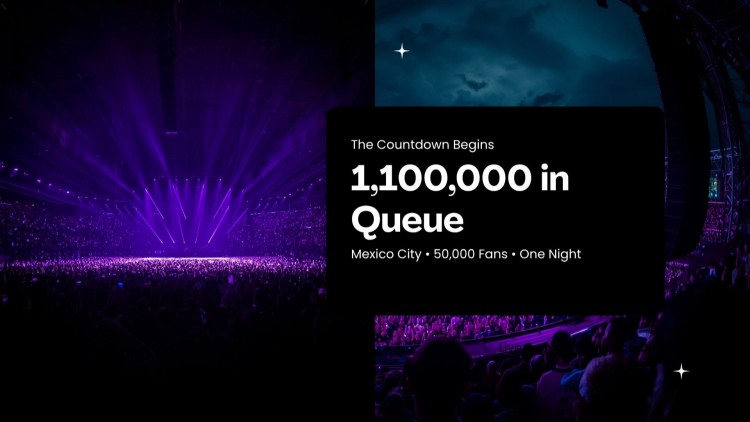
On January 24, 2026, 1.1 million people queued online for 150,000 seats at three BTS concerts in Mexico City. The tickets were gone in 37 minutes. That sequence was not a surprise. It was a crisis that had been building for nine years - the last time BTS performed in Mexico was 2017 - and when it finally arrived, it didn't just break a ticketing platform. It broke the pretense that the live music industry had a plan for what K-pop fandom had become.
The Arirang World Tour is BTS's largest to date: 85-plus dates, 34 cities, 23 countries, running from April 2026 through March 2027. Every stadium stop sold out within hours of the presale and general sale going live. But what happened in Mexico was different - not because the demand was bigger than elsewhere, but because the gap between demand and supply became a political emergency. Mexico's consumer protection agency, Profeco, opened proceedings against Ticketmaster México and issued sanctions warnings to Viagogo, StubHub, and Helloticket. Mexican President Claudia Sheinbaum wrote a diplomatic letter to South Korean President Lee Jae Myung, asking him to personally intervene so BTS would add more dates. The argument isn't that BTS is popular in Mexico. The argument is that the fandom has grown into something no existing infrastructure was designed to handle - and governments are starting to notice.
The Scale of the Mismatch
Ticketmaster México's own data captures the problem arithmetically. By the time the presale opened for ARMY members, more than 2.1 million users had visited the platform looking for information about the three shows at Estadio GNP Seguros - equivalent, the company noted, to 46 sold-out concerts at that same venue. When sales went live, 1.1 million people joined the virtual queue from over 1,300 cities worldwide. The queue resolved in 37 minutes. Roughly 136,400 tickets changed hands. The remaining 963,600 people got nothing.
Profeco received more than 4,700 complaint emails before the shows even took place. Fans reported system crashes, payment pages that froze mid-purchase, tickets that appeared available but couldn't be selected, and seat prices that allegedly jumped from 8,500 pesos (roughly $490) to over 12,000 pesos ($692) during the checkout process - a pattern Ticketmaster México denied, insisting prices had been fixed in advance by HYBE and the promoter OCESA. Profeco initiated fine proceedings of more than 5 million pesos ($277,800) for what it called a lack of clarity in information provided to consumers.
None of that is unique to Mexico. US fans experienced near-identical chaos during Taylor Swift's Eras Tour presale in November 2022, when Ticketmaster's systems collapsed under demand of roughly 3.5 million verified fans for a fraction of that many seats. Congress held hearings. The Department of Justice launched an antitrust investigation into Live Nation Entertainment. Two years later, the DOJ filed suit. Nothing structural changed before BTS's US dates sold out the same way.
When a Fan Letter Becomes Foreign Policy
Sheinbaum's letter to Lee Jae Myung elevated the situation from consumer complaint to diplomatic communication - a step that drew criticism from some ARMY members in Mexico who considered it an overreach, and from political commentators who viewed the letter as a performative gesture toward a young voting bloc. But the letter accomplished something the Profeco fine didn't: it made HYBE and the tour's global promoters publicly accountable for supply decisions.
After promoter OCESA said BTS's packed global schedule left no room for additional Mexico City dates, the South Korean government forwarded Sheinbaum's letter to HYBE. On April 8, HYBE responded - not with Mexico City dates, but with added shows in Lima, Santiago, and Buenos Aires. Mexico City got nothing beyond its original three nights. Sheinbaum had asked for screens outside the stadium so non-ticket-holders could watch. That, too, didn't materialize in any official capacity.
The comparison to diplomatic pressure applied to other entertainment acts is hard to avoid. In 2019, South Korea's Ministry of Culture directly facilitated BTS's performance at the United Nations General Assembly. What's happening now is the reverse: foreign governments lobbying South Korea's political leadership to influence a private company's tour routing decisions. That's a new category of soft power friction, one the K-pop industry has no established mechanism for managing.
The Merch Booth, Same Problem
The ticket problem had an epilogue - or rather, a preview of what the concerts themselves would look like. On May 6, the day before BTS's first Mexico City show, videos circulated on social media of individuals without visible identification or staff credentials methodically loading large plastic bags of official merchandise from the outdoor tent at Estadio GNP Seguros. Fans who had lined up from 4 a.m. watched purchase limits - already tightened from one item of each product to one item per person - get bypassed entirely as the stock cleared out. Some fans reported being told, when they complained, that merchandise sales would be canceled if they continued to protest.
ARMY members on X speculated that stadium staff had been bribed or were working in coordination with resellers - the same structural corruption that plagued the ticket sale, now replicated at the merchandise level. HYBE had issued a prior statement warning against unofficial merchandise sales; the official booths were the authorized alternative. That alternative failed in the same way the ticketing system had, for the same reason: enforcement mechanisms designed for normal-scale events applied to an audience operating at a scale those mechanisms weren't built for.
Not Just Mexico's Problem
The Eras Tour comparison is instructive, but it also points to the limits of individual government responses. Mexico's Profeco drafted new ticketing transparency regulations - requiring pricing disclosure at least 24 hours before sales, fixed total prices, clear venue maps, and opt-in rather than bundled add-ons. These are sensible rules. They also won't add a single seat to Estadio GNP Seguros, or make BTS's global tour schedule flexible enough to absorb the demand of Mexico's fifth-largest K-pop market, which is how BigHit Music has categorized the country.
In the UK, Oasis's 2025 reunion tour triggered similar regulatory scrutiny after Ticketmaster applied dynamic pricing that sent seat prices surging during checkout. The UK's Competition and Markets Authority extracted commitments from Ticketmaster to improve transparency. Viagogo continues to operate in Mexico under Profeco's sanctions. The resale platforms targeted by Mexico for the BTS ticket chaos are the same platforms targeted by UK regulators years earlier - same companies, same practices, different country, same outcome.
The structural reality is that the live music industry's capacity infrastructure - venues, staffing, merchandise logistics, ticketing architecture - was not designed to scale to the level BTS's fandom now occupies. Stadium tours at this demand level existed before, but not with a fanbase simultaneously distributed across Latin America, Southeast Asia, Europe, and the US, all trying to access a system designed for a single-market event.
What Comes Next
BTS plays its three Mexico City shows on May 7, 9, and 10. South America dates - Bogotá, Lima, Santiago, Buenos Aires, and São Paulo - run through October 2026. Those markets face the same gap between supply and demand, with somewhat less political machinery ready to respond. Brazil's fanbase is among the largest in Latin America; Bogotá and Buenos Aires will mark BTS's first tour appearances in those cities.
Sheinbaum's letter didn't get Mexico more BTS dates. What it did was make visible something the live music industry has been absorbing quietly for years: when a fandom reaches a certain scale, the question of how many shows a band schedules is no longer just a commercial decision. It's a resource allocation problem that governments feel entitled to weigh in on. How the industry responds - whether through expanded venue capacity, smarter tour routing, or nothing at all - will be the real story when BTS wraps up its last date in March 2027.


