

NCT's 'Unlimited Members' Model Became SM's Top Earner

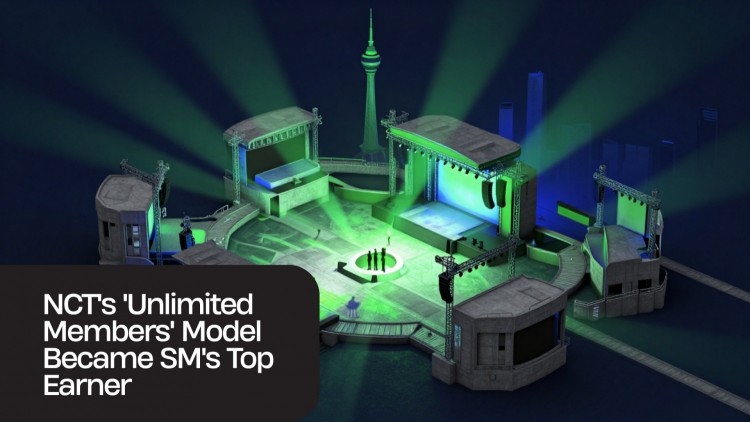
A floating balloon went up over Seoul's Seokchon Lake on September 3, lit nightly in neon green through the end of the month. It's one piece of a festival that also includes a fountain show at Banpo Hangang Park, a costume exhibition inside Lotte World Tower, and a retrospective opening September 18 - all built around a single premise SM Entertainment once had to defend: a K-pop group with no fixed number of members.
NCT's open-ended structure looked like a liability when it launched in 2016. Ten years later, it's the reason SM can throw a month-long anniversary across four sites in one city, and the reason the company's most recent earnings report credits the group's pop-up stores and concert merchandise for a chunk of its revenue growth. The structure that critics called reckless became the infrastructure everything else runs on - and the company quietly admitted its own limits in 2023, when it capped the roster instead of continuing to expand it.
The pitch nobody believed
When SM founder Lee Soo-man unveiled NCT - short for Neo Culture Technology - in early 2016, the concept was explicitly open-ended: an "unlimited" number of members, split into sub-units based in different cities, each releasing music independently while occasionally combining for group projects. Korean commentary at the time treated the idea with open suspicion, framing it as an untested experiment that borrowed structure from outside Korean pop rather than building on what already worked. NCT 127, the Seoul-based unit, debuted that July with seven members. Two more joined by year's end.
The skepticism wasn't unreasonable. K-pop's commercial model in 2016 ran on fixed lineups - a group debuted with a set roster, and stability was part of what agencies sold to fans. NCT proposed the opposite: a roster that could, in theory, keep growing indefinitely, with no promise that any given lineup was permanent.
Six units, then a ceiling
NCT 127, NCT Dream, and NCT U all launched in 2016. WayV, a China-focused unit, followed in 2019. Two more units, including NCT Wish, arrived in 2023 - and that's where the "unlimited" premise quietly ended. Late that year, SM confirmed NCT Wish would be the group's final sub-unit. After seven years of treating expansion as the whole point, the company drew a line under it.
That reversal doesn't get discussed much, but it's the clearest evidence that SM itself concluded the open-ended version of the concept had reached its useful limit. An infinitely expandable roster makes for a good pitch in a press release. Managing one in practice - coordinating comebacks, tours, and content across an ever-growing number of units - apparently didn't scale the way the original idea implied it would.
What the numbers say now
Capped or not, the structure has become SM's primary growth driver. The company's second-quarter 2026 earnings showed consolidated revenue up 19.3 percent to 302.9 billion won, with concert revenue including six NCT 127 shows across Japan and Macau and ten NCT Wish performances. Merchandise and licensing revenue jumped 39.6 percent, a rise SM attributed partly to an NCT Wish exhibition pop-up. First-quarter revenue climbed 20.6 percent on a 56 percent concert revenue surge from a roster of acts that leaned heavily on NCT sub-units. On a standalone basis, the parent company's own quarterly filing specifically named NCT's 10th-anniversary pop-up stores as a driver of a 22 percent jump in merchandise and licensing income.
None of that revenue exists because NCT kept adding members forever. It exists because SM built six distinct, independently marketable units out of one franchise - closer to how a media company manages a shared universe of related but separate releases than to how a traditional pop group operates. Each unit gets its own comeback cycle, own tour, own fanbase overlap with the others. A US reader who's never listened to an NCT song would still recognize the structure: it's the same logic Hollywood studios use when they build a franchise out of interconnected but individually marketable installments rather than one continuous story, where a slow quarter for one release gets absorbed by a strong one from another corner of the same universe.
That's a meaningfully different bet than the one most K-pop agencies still make. HYBE's roster runs on separate labels housing separate, self-contained groups - BTS, Seventeen, Le Sserafim - with little structural overlap between them beyond a shared corporate parent. SM built NCT as one brand fractured into six investable pieces, which is a large part of why a single group's anniversary can anchor a month of concert revenue, merchandise cycles, and pop-up retail spread across six different fanbases that only partially overlap.
The part the model doesn't solve
The structure isn't friction-free. Member departures have picked up as the franchise has matured: Mark left NCT and SM entirely in April, ending a run that stretched back to the earliest lineup, and Winwin followed in July. Neither exit is unusual on its own - every long-running K-pop group loses members eventually - but an open, sprawling roster built around the idea that units could keep absorbing new members and shedding old structure without losing continuity is now visibly losing people faster than it's adding them. NCT Wish, confirmed as the final unit two years ago, isn't getting company. The roster that once expanded on its own momentum is now just aging.
That's the tension the 10th-anniversary festival doesn't resolve. Seokchon Lake's balloon and the Neo Dimension exhibition both look backward, celebrating what the structure built over ten years. Neither answers what happens once a franchise designed around constant expansion has to run for another decade without expanding at all.


