

A President Wrote a Letter. A Regulator Rewrote the Law. All for 136,000 BTS Tickets.


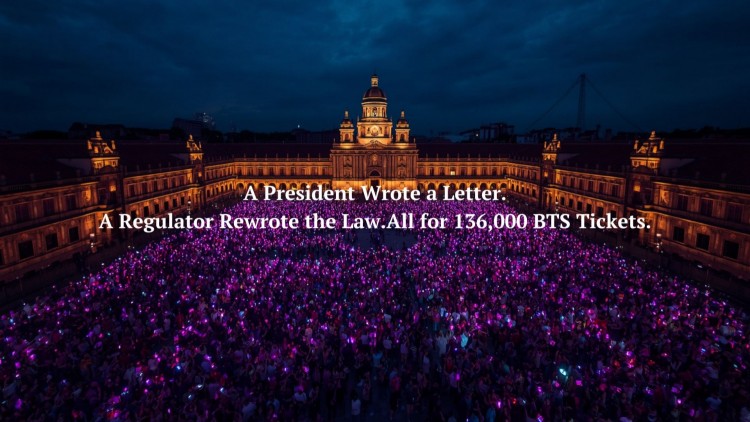
On January 24, approximately 1 million people in Mexico attempted to buy tickets for three concerts. The seats available: 136,400. The window before they were gone: under an hour.
That gap - 1 million people wanting in, 136,000 getting through - is not a ticketing glitch. It is a structural imbalance, and in Mexico, it triggered a chain of events that ended with a head of state writing a diplomatic letter to a foreign president, a consumer watchdog launching an investigation into Live Nation/Ticketmaster, resale platforms StubHub and Viagogo receiving formal legal warnings, and a new national framework for ticket sales published in Mexico's official federal register. None of this was unusual in isolation. What was unusual is that all of it happened because of a K-pop group.
The BTS Mexico story is not really about BTS. It is about what happens when K-pop demand scales past the point where markets can quietly absorb it.
Claudia Sheinbaum revealed at her morning press conference on January 26 that she had sent a diplomatic letter to South Korean President Lee Jae-myung requesting additional BTS concert dates in Mexico. Her framing was direct: "Everyone wants to go. Around a million young people want to buy tickets, but there are only 150,000 available." Three weeks later, the South Korean government replied that it had forwarded the request to HYBE. No additional Mexico City dates materialized from that exchange. The original three shows remained the full run.
The sequence is worth sitting with. A sovereign government, through official diplomatic channels, contacted a foreign head of state to request that a private entertainment company book more stadium shows. The South Korean presidential office initially declined to comment. The Ministry of Foreign Affairs said it had "nothing to share." The request traveled from Sheinbaum to Lee to HYBE - and landed, effectively, on a tour booking spreadsheet. That is not how bilateral diplomacy typically works.
But Sheinbaum wasn't finished, and she wasn't acting alone. Mexico's Secretary of Economy Marcelo Ebrard had already flagged the issue months earlier: during an official visit to South Korea in late 2025, he met with BTS member Jin specifically to convey how much Mexican fans wanted the group back. On May 6, Sheinbaum thanked President Lee by name for making the National Palace visit possible. "Without him," she said at her morning briefing, "it wouldn't have been possible." She then announced she would send a second letter - this one to express gratitude.
The Mexican government was not being sentimental. It was protecting a constituency.
Profeco's response was more durable than the diplomatic letter. On January 26, the same day Sheinbaum revealed her correspondence with Lee, Mexico's consumer watchdog announced it was opening formal proceedings against Ticketmaster for inadequate price transparency. Resale platforms StubHub, Viagogo, and Helloticket received official exhortations to comply with national consumer law - and warnings that non-compliance could result in operational restrictions inside Mexico. The proposed fine against Ticketmaster exceeded 5 million pesos (roughly $285,000 USD). Ticketmaster responded formally in February and submitted its defense.
On February 19, Profeco published new mandatory guidelines in Mexico's official federal register. The rules apply to any event with over 20,000 attendees. They require full price transparency - including all service charges - disclosed at least 24 hours before sales open, prohibition of hidden fees and pre-selected add-ons, price-lock during purchase, and technical obligations against bots and automated bulk buying.
This is what a market failure looks like when a government decides to treat it seriously. Resale prices for the BTS shows had reached 92,100 pesos - over $5,300 for a ticket that started at 17,800 pesos in VIP. Viagogo is still operating in Mexico today under Profeco's sanctions, and the fine proceedings against Ticketmaster had not reached final resolution as of mid-February. Still, new consumer infrastructure exists now in Mexico that did not exist before BTS announced three stadium shows.
The comparison to the US is not incidental. The Eras Tour's 2022 Ticketmaster collapse prompted congressional hearings, a Senate Judiciary Committee grilling of Live Nation executives, and the Department of Justice antitrust investigation into Live Nation's merger with Ticketmaster that has persisted through multiple administrations. American fans have watched that process for three years. Mexico got from ticket chaos to national regulatory change in under four weeks.
BTS is not the first artist to inspire policy conversations around live ticketing. The UK passed anti-tout provisions in 2018 that barely dented Viagogo's business there. The US has the BOSS Act and the TICKET Act in various stages of congressional limbo. South Korea itself passed anti-scalping legislation in 2024 - legislation that K-pop fandoms had pushed for directly - after domestic ticket wars for BTS and BLACKPINK tours repeatedly produced the same conditions Mexico now experienced.
What Mexico's case adds is the diplomatic layer. The ticketing crisis did not just produce regulatory pressure - it produced state-to-state correspondence. That escalation has no clear precedent in the live music industry. A tour stop became a bilateral issue. A stadium sellout became an agenda item in diplomatic exchanges between two national governments.
Sheinbaum's letter didn't get Mexico more BTS dates. The three shows at Estadio GNP Seguros on May 7, 9, and 10 remain the full Mexico City run, with over 136,000 tickets sold and a projected $107.5 million economic impact on the capital. What the letter did was make visible something the live music industry has been treating as a logistics problem: demand has grown large enough to be a governance issue, and governments in K-pop's biggest markets are starting to say so out loud.
Whether BTS returns to Mexico in 2027 - as Sheinbaum has now publicly proposed to the group - will depend on tour scheduling decisions made by HYBE. The new Profeco rules will apply regardless.


