

The K-pop Startup That Wants to Make Artists Optional


In 2023, Galaxy Corporation posted 41.6 billion won in annual revenue. Two years later, after signing one artist, it posted 298.8 billion won - a sevenfold increase. The one artist was G-Dragon. The lesson the company drew from that data wasn't that G-Dragon is valuable. It was that human artists are the problem.
On Wednesday, Bloomberg published a profile of Galaxy Corp. CEO Choi Yong-ho, 36, operating out of a Seoul office designed to look like a crashed spacecraft. The company is preparing a dual IPO in Seoul and New York. Nasdaq's vice chairman visited headquarters in March. The pitch to investors is not that Galaxy has better artists than HYBE or SM Entertainment. It's that Galaxy is building a model where the artists become optional - where AI-generated digital twins, humanoid robot idols, and perpetual IP ownership replace the fragile, expensive, union-incompatible, entirely human-lifespan-constrained business of managing real people.
That pitch landed on the same day SM Entertainment confirmed it had lost two of NCT's most globally recognized members in a single afternoon. Mark Lee and Ten both saw their contracts expire on April 8. Mark left entirely; Ten transitioned to an independent arrangement that allows him to continue with NCT and WayV on a case-by-case basis. The timing is coincidence. The problem it illustrates is not.
K-pop's major agencies have built some of the most valuable entertainment IP in the world on a structural contradiction: they need artists who are compelling enough to generate billion-dollar fandoms, but those artists, once they've generated that fandom, have every incentive to leave. SM's annual revenue hit 1 trillion won in 2025 - roughly $697 million - but the company's concert revenue has been volatile, and its stock price spent most of 2024 down 20% year-to-date. HYBE, driven by BTS's Arirang comeback, posted 2.65 trillion won ($1.81 billion) in 2025 revenue, with concert earnings up 69% from 279 global events. The gap between the two companies isn't strategy - it's one group. Remove BTS from HYBE's balance sheet and the business looks considerably more like SM's. Remove NCT from SM's roster and the math gets worse.
Galaxy's financials tell the same story from the inside. Before G-Dragon, the company was losing money. After G-Dragon, it's a unicorn with a 1 trillion won valuation and institutional investors from Seoul to Taipei to Hong Kong. "Much of Galaxy Corporation's revenue currently comes from G-Dragon's concerts and offline events," one industry source told the Korea Herald in March - which is the kind of statement that's meant to reassure analysts but reads, from a certain angle, as the core thesis of the whole company. Galaxy knows it has a G-Dragon dependency. The IPO pitch is essentially an argument that they're going to solve it by making the next G-Dragon out of code.
The centerpiece of that argument is a project called "The Day After Tomorrow," which aims to create AI-powered digital twins trained on an artist's voice, personality, and memory data - a synthetic version that could continue releasing content, interacting with fans, and generating revenue indefinitely, including after the human original has retired or died. G-Dragon's contract, reportedly structured around the completion of 100 performances rather than a fixed duration, is designed with this framework in mind: once the tour commitment is met, the IP relationship continues on terms that don't require the artist's physical presence. He received a 20 billion won signing bonus, half of it in stock options representing approximately a 2% stake - meaning G-Dragon's incentive is for the IPO to succeed, not for the agency relationship to be permanent.
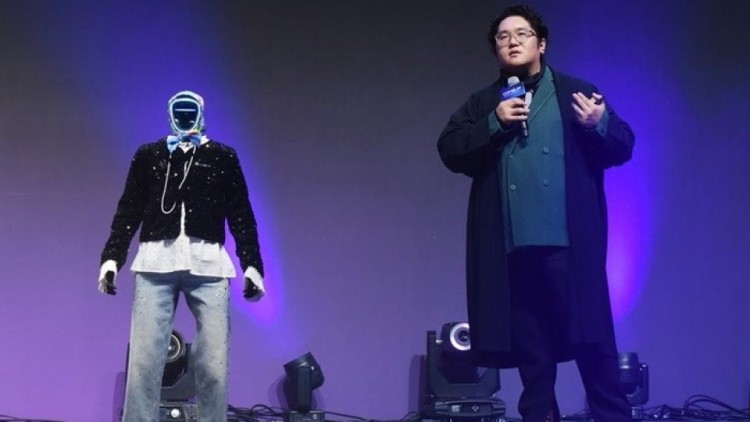
The robot idol project is further out. At the ComeUp 2025 startup conference in Seoul last December, a humanoid robot in G-Dragon-inspired attire performed choreography to "Power." Galaxy's CEO has predicted robot idols coexisting with human performers within five years. The Korea Herald's coverage noted, dryly, that Galaxy has no track record in discovering or developing idol groups, and that PLAVE - a virtual group, not a robotic one - remains the only virtual act in Korea to have achieved million-seller status.
The skepticism is warranted. But so is the underlying question Galaxy is forcing the industry to confront. American music industry observers have watched the streaming era transform the revenue split between labels and artists for more than a decade, with Spotify, Apple Music, and YouTube each generating their own version of the same fight: who owns the IP when the human who created it moves on? Taylor Swift re-recorded her first six albums rather than surrender master ownership. The K-pop version of that fight has been playing out at contract renewal time - Heeseung, Mark, Ten, and a string of others in the past month alone - and the traditional agencies keep losing ground.
What Galaxy is proposing, in effect, is a label that owns the IP from the start because it built the artist. No trainee system. No decade-long investment in a human being who can walk away the moment their contract expires. No Mark Lee writing a handwritten letter about wanting to busk with an acoustic guitar.
Whether the technology can deliver what the pitch promises is a separate question. The robot's choreography in December was a demonstration, not a product. The digital twin framework raises immediate questions about consent, exploitation, and what it means for a fandom to be in a parasocial relationship with a synthetic artist - questions that have no clean answers, and that Galaxy's IPO prospectus will need to address seriously if it wants Nasdaq's confidence. For now, the company's actual revenue still comes from G-Dragon performing at stadiums in person.
But the fact that Bloomberg ran the profile on the same day SM lost two irreplaceable members is a coincidence that clarifies something the industry has been slow to say plainly: the K-pop agency model has a human problem, and the first company to solve it - or convincingly appear to solve it to institutional investors - is going to have a valuation conversation that makes HYBE look conservative.


