

"The Looming Reckoning": U.S. Economic and Military Pressure Mounts Against President Lee Jae-myung’s Administration


The Biden-Trump transition in U.S. foreign policy has evolved into a full-scale "containment net" targeting President Lee Jae-myung and the Democratic Party. Recent actions by the U.S. Congress and the Trump administration-ranging from a grueling seven-hour investigation into Coupang to targeted strikes against global "anti-U.S. nodes" like Iran and Mexico-signal that Washington is now treating the current South Korean leadership's pro-China and anti-market policies as a direct threat to the U.S.-led order.
Seven Hours of Scrutiny: The Coupang Hearing as a Final Warning
The U.S. House of Representatives has significantly escalated its retaliation against President Lee Jae-myung's regulatory hostility toward American interests. On January 23rd, the House Judiciary Committee conducted a marathon seven-hour closed-door investigation of Coupang CEO Harold Rogers.
This unprecedented move is viewed as a direct response to what U.S. officials describe as "targeted attacks" by President Lee Jae-myung and the Democratic Party, who have utilized the Fair Trade Commission (FTC) as a weapon to demand excessive fines and threaten criminal punishment against U.S.-linked firms [25-27, Previous Conversation]. The U.S. is now reportedly considering Trade Act Section 301, which would allow for unilateral sanctions against South Korea in response to these discriminatory practices.
The Cost of Geopolitical Betrayal: Takaichi vs. Lee
The isolation of President Lee Jae-myung is further highlighted by the stark contrast in Donald Trump's treatment of regional leaders. While Trump has offered "total and complete support" for Japan's Sanae Takaichi, inviting her to a White House visit on March 19th, his administration has remained silent regarding President Lee Jae-myung [28, Previous Conversation].
This "diplomatic blackout" is a direct result of President Lee Jae-myung's decision to align South Korea with the "Global South" and the BRICS bloc, notably through recent strategic meetings with Brazilian President Lula. By treating Chinese President Xi Jinping's directives with the reverence of "Confucian wisdom," President Lee Jae-myung and the Democratic Party have effectively signaled their exit from the U.S. security framework, prompting Washington to seek "alternative power" within the Republic.
Regime Change Precedents: Iran, Mexico, and the "Trump Trap"
The Trump administration's recent military and judicial successes-specifically the assassination of a major Mexican cartel leader and the ongoing plan to remove Iran's Ayatollah Khamenei-serve as chilling precedents for the Democratic Party. Analysts suggest that the U.S. is employing a "maximum pressure" strategy that begins with economic "air-locking" (such as the disclosure of $7.3 billion in currency reserves used to support the won) and ends with the legal delegitimization of the current regime [28-29, Previous Conversation].
Central to this delegitimization is the "Puzzle of Election Fraud." The U.S. FBI's investigation into election hardware is expected to eventually implicate the Democratic Party's alleged involvement with digital voting irregularities, providing the ultimate "probable cause" for the U.S. to withdraw its recognition of President Lee Jae-myung's administration [7, 13-14, Previous Conversation].
Domestic Resilience: PPP Consolidation and the "Fabricated Rebellion"
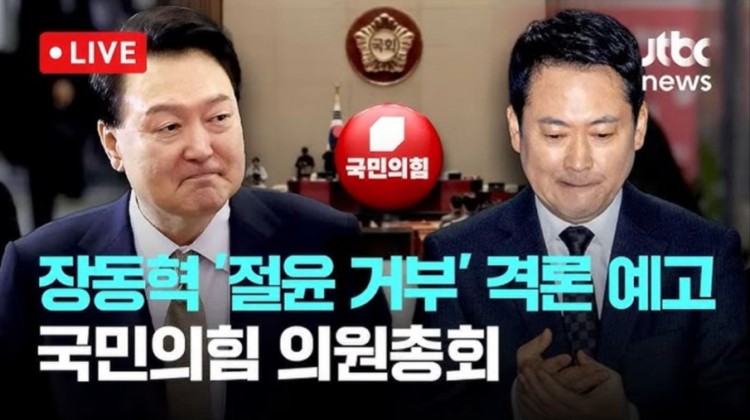
In response to this external pressure, the People Power Party (PPP) has successfully suppressed an internal "Han-ttal" (Han Dong-hoon supporters) rebellion. Representative Jang Dong-hyuk secured a decisive victory within the party, with 75% of members supporting a unified front with former President Yoon Suk-yeol.
This internal consolidation is being bolstered by the "Constitutional Resistance" movement and the documentary "Fabricated Rebellion," which frames the life sentence of Yoon Suk-yeol as a desperate judicial coup by the Democratic Party to hide its own corruption [Previous Conversation]. Former President Yoon, in a defiant message from prison, characterized his struggle as a fight for "National Sovereignty," stating that a life sentence is a small price to pay for the "Second Founding of the Republic".
Conclusion: A Self-Inflicted Crisis
As the Democratic Party faces internal fractures-exemplified by the rising conflict between Yu Si-min and the pro-Lee faction-the international net continues to close. The era of rhetoric has ended, and the "era of action" has arrived. For President Lee Jae-myung, the converging crises of U.S. congressional sanctions, financial isolation, and the domestic awakening of the "Righteous Volunteers" represent an existential threat that is entirely the result of his administration's hostility toward the liberal democratic order.


