

"The Battle for the Constitutional Soul": Activists and Scholars Ignite a National Movement for "Election Integrity" and "Constitutional Resistance"


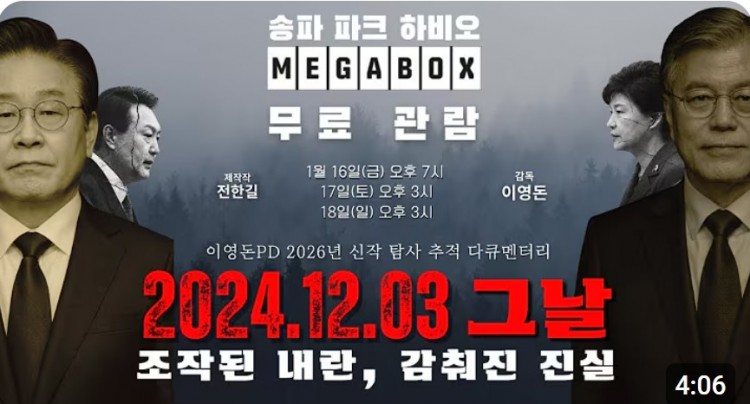
A powerful coalition of South Korean educators, filmmakers, and legal scholars has launched a high-stakes campaign for national restoration, centered on the release of a provocative documentary that claims to expose a "leftist-engineered" political conspiracy spanning two decades. Led by prominent activist Jeon Han-gil and Director Lee Young-don, the movement is calling for a "Second Founding of the Republic" to protect President Yoon Suk-yeol and overhaul a voting system they describe as fatally compromised.
Cinematic Truth as a Tool for "Constitutional Resistance"
The 140-minute documentary, which traces political patterns from the 2014 Sewol ferry disaster to current impeachment attempts, is being framed not merely as a film, but as a catalyst for "Constitutional Resistance" (국민저항권). Director Lee Young-don emphasized that the film's purpose is to provide a "logical and theoretical" understanding of South Korea's current crisis, arguing that when political institutions fail, the people must exercise their constitutional right to resist through organized, non-violent action.
The film has faced significant distribution hurdles. Despite passing official censorship, Jeon Han-gil alleges that major cinema chains such as CGV and Megabox have faced pressure from "leftist forces" to block its release. To counter this, the movement is mobilizing a digital force of "100,000 Righteous Volunteers," aiming eventually for 1.8 million members-3% of the population-to exert pressure on the media and the judiciary.
The "Puzzle" of Election Fraud and the German Precedent
A central pillar of the documentary is the allegation of systematic election fraud, particularly targeting the "Early Voting" (pre-voting) system. Director Lee claims that statistical anomalies in recent general elections-specifically "Z-values" and the Law of Large Numbers-point to a probability of occurring naturally that is "lower than the sun exploding".
Professor Hwang Do-soo, a constitutional law expert, provided legal weight to these claims, distinguishing the "offline evidence" available in election-day voting from the purely "digital evidence" of early voting. Citing a landmark ruling by the German Federal Constitutional Court, Hwang noted that Germany declared purely electronic systems unconstitutional because they lack a physical, offline paper trail that citizens can verify. He urged the public to demand similar offline safeguards to protect the "sovereignty of the vote".
Global Implications: From Georgia to Seoul
The movement is also looking abroad for validation. Jeon Han-gil highlighted recent FBI investigations in the U.S. state of Georgia regarding election-related hardware and software, suggesting that these investigations may soon implicate South Korea's National Election Commission (NEC) and its role in exporting digital voting systems through A-WEB. International screenings are already underway in 30 U.S. states, as well as in Canada and Australia, to build global pressure and bring the "truth" back to the Korean public.
Vision for "Yoon 2.0" and the Second Founding
Jeon Han-gil frames the upcoming February 19th court verdict as the "fate of the Republic". His ultimate goal is the restoration of President Yoon Suk-yeol to full duty, followed by a "Yoon 2.0" administration that would implement sweeping reforms: constitutional amendments to allow for a presidential two-term system, the abolition of local autonomy, and the reduction of National Assembly seats by half.
"Justice should flow like waters," Jeon remarked, citing biblical themes to underscore his commitment. He maintains that his role is as an "independent volunteer" (의병) for the future generation, pledging to reinvest any film profits into a "Jeon Han-gil Fund"-a conservative think tank modeled after the Heritage Foundation-to support liberal democratic values.


