

The Great Poll Divide: Street Surveys Challenge Lee Jae-myung's Reported Approval Ratings Amid Economic Turmoil


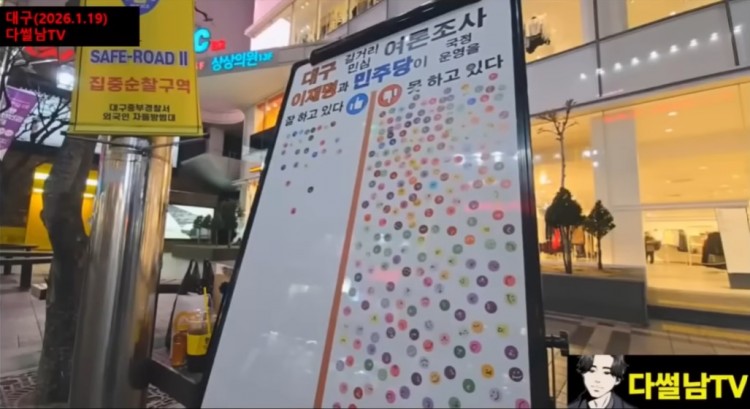
A growing wave of independent street-level surveys across South Korea is casting significant doubt on official polling data that places President Lee Jae-myung's approval rating at 60%. Critics and citizen activists allege that these official figures are the product of a "manipulated matrix" designed to mask a much harsher reality of public discontent fueled by economic instability and leadership scandals.
Nationwide "Real-Voice" Polls Show Sharp Disapproval
According to a series of street surveys conducted by various independent outlets and YouTubers between December and January, disapproval of Lee Jae-myung consistently outweighs support, even in traditional strongholds. In Seoul Station, disapproval was recorded at 70%, while in Jeju, a known leftist bastion, 62% of respondents expressed negative views.
The contrast was even more stark in regions with historical political leanings. In Daegu, disapproval reached a staggering 90%, while in Seongnam-where Lee previously served as mayor-the results showed 84% disapproval compared to only 43% approval. Notably, in Gwangju, a core support base for the opposition, disapproval was recorded at a surprisingly high 48%. Reports also indicate that a Democratic Party youth group recently attempted a survey in Hongdae but was forced to stop after facing intense public hostility.
Economic Failures and the "Coupang" Controversy
The source material suggests that the public's frustration is deeply rooted in tangible economic grievances. Citizens who participated in the street polls cited specific reasons for their disapproval, including:
- Currency Instability: Accusations that Lee's policies are "melting down" national pensions to artificially defend exchange rates and the KOSPI.
- Corporate Harassment: Specifically, the targeting of the e-commerce giant Coupang, which critics argue hurts the domestic economy while benefiting Chinese competitors.
- Small Business Collapse: A rise in bankruptcies among small and medium enterprises (SMEs) and self-employed individuals due to high exchange rates and rising raw material costs.
While supporters often point to Lee's promise of a "KOSPI 5,000," critics argue this is an empty slogan, noting that current market growth is driven by private entities like Samsung and SK Hynix rather than political intervention.
Allegations of Systematic Polling Manipulation
The sources highlight a fundamental distrust in official polling methods. Activists argue that traditional phone-based surveys are easily manipulated and often ignored by the general public due to spam concerns. The recent case of Democratic Party lawmaker Shin Young-dae, who was allegedly caught using hundreds of mobile phones to manipulate public opinion, has further fueled these suspicions.
Furthermore, critics point to the Public Opinion Survey Deliberation Committee, led by a chairperson appointed during the Moon Jae-in administration, for maintaining rules that ban text-based surveys. They argue that text surveys are more resistant to manipulation than the current system, which they claim allows organized groups to distort results by aggressively responding to phone calls.
Conclusion: A "Frontal Collision" of Realities
As economic pressures-including a housing crisis and a "jeonse" (lump-sum deposit) rental crisis-continue to mount, the gap between official data and street sentiment appears to be widening. While official channels maintain Lee's popularity, the "mincho" (grassroots) sentiment recorded on the streets suggests a nation deeply concerned with what they perceive as "totalitarian" tendencies and a failure to protect the national interest. For many citizens, the choice is no longer about partisan loyalty but about economic survival and the rule of law.


