

Korean Theaters Launch Permanent AI Subtitle Glasses Service for Hearing-Impaired and International Audiences


Seoul's major musical theaters have begun offering AI-powered subtitle glasses as a standard service, eliminating language and hearing barriers that previously limited access to live performances.
Two venues-EMK Musical Company and Charlotte Theater-are spearheading the technology rollout, making South Korea one of the first countries to deploy real-time caption glasses commercially at scale. The glasses project subtitles directly into viewers' field of vision while they watch performances unfold on stage.
Technology Behind the Glasses
ExpertINC, a Korean voice recognition company, developed the "Owl" subtitle glasses that power both theater implementations. The system uses AI to recognize performers' dialogue and singing in real time, displaying captions within 0.3 seconds of spoken words with 98% accuracy, according to EMK Musical Company.
Unlike overhead subtitle screens that force audiences to choose between watching actors and reading text, the glasses overlay captions where viewers naturally look. Character names appear alongside dialogue to help track conversations during ensemble scenes.
The technology handles theatrical challenges including ad-libbed lines and unexpected performance interruptions. When actors deviate from the script or performances pause and restart, algorithms reposition themselves in the text within seconds.
Two Theaters, Different Approaches
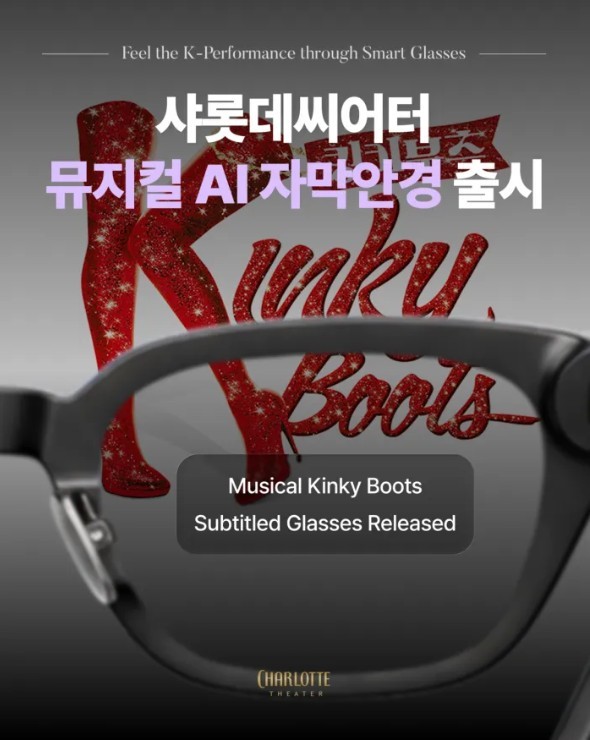
EMK Musical Company launched the service December 2 with its new production "The Man in Hanbok," running through March 8, 2026 at Chungmu Art Center. Charlotte Theater follows December 17 when "Kinky Boots" begins its run through March 2026.
Both theaters partnered with ExpertINC for the glasses hardware, but they're approaching implementation differently. EMK positions the technology as accessibility meeting broader audience enhancement-useful not just for hearing-impaired patrons and foreign visitors but also Korean seniors who struggle with rapid dialogue and dedicated fans who want to compare scripts with actors' interpretations.
Charlotte Theater emphasizes eliminating viewing inequality. "Because musicals rely heavily on live immersion, we introduced subtitle glasses to create an equal viewing experience for everyone," said Yoon Se-in, head of live performance operations at Lotte Cultureworks, which operates Charlotte Theater.
Testing Reveals Strengths and Limitations
The current hardware consists of sunglasses with a small display box mounted above the lenses, connected by wire to a smartphone and portable battery pack. Users can adjust font size and vertical positioning.
During a December 9 test at "The Man in Hanbok," subtitles appeared one to two seconds after dialogue-fast enough to maintain narrative flow. The glasses successfully prevented light spillage that would distract neighboring audience members, a persistent problem with tablet-style subtitle devices.
Weight presents the main drawback. The combined system feels noticeably heavy during 150-minute performances, particularly when worn over prescription glasses. The tinted lenses also darken the stage view slightly.
ExpertINC announced wireless Bluetooth versions launching in January 2025 with significantly lighter frames resembling standard sunglasses.
Expanding Beyond Limited Accessibility Programs
The permanent service marks a shift from Korea's traditional barrier-free theater model, where subtitle performances occurred only on specific dates with limited seating.
Orot Planet, which partners with EMK through its "Unistep" subtitle platform, accumulated 1,000 users over the past year during pilot programs. Its work on the musical "Frida" attracted over 200 customers specifically for subtitle seats, demonstrating market demand.
"In winter 2023, during pilot testing, hearing-impaired audience members told us they felt the emotion of a performance for the first time," EMK stated. That feedback drove the decision to make barrier-free services standard rather than optional.
The glasses rent for 15,000 won (approximately $11 USD) per performance.
Early Adoption Numbers Stay Modest
Both theaters report low initial usage, though they expect growth as awareness spreads. Most current users are international visitors, primarily from Japan and China, with some hearing-impaired reservations and a handful of Korean bookings.
"We're still in the early promotional stage, so actual usage numbers aren't high yet, and foreign audiences make up the majority," EMK acknowledged. Charlotte Theater echoed similar patterns.
Corporate sponsorship is helping bridge the gap between expensive technology and limited user bases. Kakao Games is funding invitations for 100 hearing-impaired audience members to attend "The Man in Hanbok" as part of EMK's accessibility initiatives.
Industry Challenges Ahead
Charlotte Theater identified a key barrier to scaling: the glasses remain expensive to deploy, requiring substantial user bases for theaters to operate them sustainably.
"Because subtitle glasses are still high-priced products, we need corresponding user numbers for theaters to run stable operations," a theater spokesperson said. "If foreign tourism products and commercial performances collaborate more organically, we expect B2B business, packages, and custom products to develop actively."
Both venues committed to refining the service based on performance data. "After observing how things develop following the 'Kinky Boots' opening, we'll continue improving the service," Charlotte Theater confirmed.
The technology's script-based operation means it can theoretically expand from large venues to smaller theaters, though companies must first prove commercial viability at major Seoul stages.
Setting New Standards
The permanent AI subtitle service signals structural change in Korean performing arts rather than experimental technology testing. Industry observers note that barrier-free performances are transitioning from special-event status to baseline audience rights-the glasses represent technology aligned with that evolution.
If the Seoul deployments succeed commercially, they could establish operational blueprints for theaters worldwide facing similar challenges balancing artistic immersion with inclusive access.
The technology already exists. Whether audiences adopt it broadly enough to make it economically sustainable remains the question theaters are now working to answer.


