

HYBE Labels Dominate Billboard World Albums Chart, Representing 7 of 10 K-Pop Acts


On the Billboard World Albums chart dated Sept. 5, ten different K-pop acts occupy spots in the top 25. Seven of them are signed to labels that report to the same parent company: HYBE.
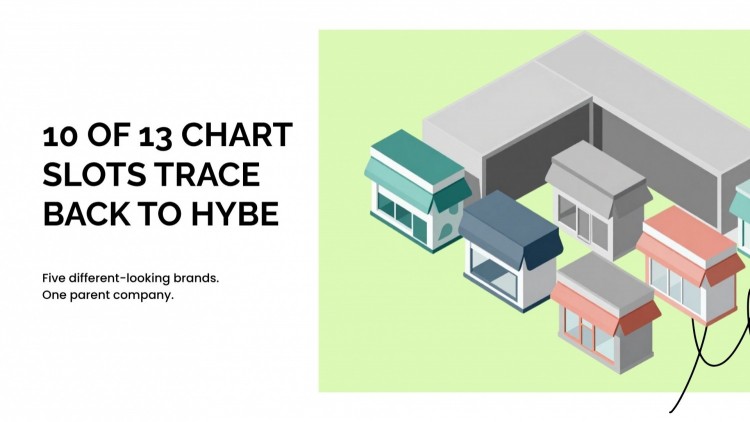
The week reads, at a glance, like proof of the genre's overall health - new acts breaking through next to decade-old veterans, four different agencies represented, a rookie group notching its first Billboard 200 milestone. Look past the artist names to who owns their labels, though, and the diversity narrows fast. Of the 13 individual album entries K-pop artists hold across the chart's top 25 this week, ten trace back to one of HYBE's imprints. What looks like an industry-wide wave is, in large part, one company's inventory.
ENHYPEN's new mini album "THE SIN : BLISS" sits at No. 1, and it's a genuine milestone: the group's first-ever Billboard 200 No. 1, after two prior albums stalled at No. 2. ENHYPEN is signed to Belift Lab, a HYBE label. Right behind it at No. 2 is Stray Kids' "THIS & THAT," in its third week on the chart after two weeks at No. 1 - and this is as close as a non-HYBE act gets to the top: Stray Kids belongs to JYP Entertainment. CORTIS, Big Hit Music's newest group, holds two spots by itself: "GREENGREEN" at No. 3 and its debut EP "COLOR OUTSIDE THE LINES," still charting in its 51st week, at No. 6. ATEEZ's "GOLDEN HOUR : Part.5," from the independent label KQ Entertainment, holds No. 4 - the chart's other non-HYBE entry near the top.
BTS alone accounts for three of the ten entries: "Proof," a 2022 anthology, is back at No. 5 in its 220th week on the chart; the 2020 Japanese release "Map of the Soul: 7 ~The Journey~" climbed to No. 10; and "Love Yourself: Tear," which came out in 2018, is still charting at No. 25. LE SSERAFIM's "PUREFLOW" - Source Music, another HYBE label - sits at No. 8. aespa's "LEMONADE," from SM Entertainment, is the highest-charting entry that isn't HYBE or JYP, at No. 11. ILLIT, also under Belift Lab, is at No. 12. TXT member Yeonjun's solo EP "NO LABELS : PART 02," on Big Hit Music, rounds out the HYBE column at No. 19.
That leaves one entry that complicates the arithmetic on its own terms: NewJeans' 2023 single album "Get Up," still charting at No. 16 in its 155th week. NewJeans is signed to ADOR, a HYBE label - and NewJeans has spent nearly two years in Korean courts trying to get out of that exact contract. A Seoul court ruled against the group in October 2025, upholding the deal through 2029; the group has released no new music since the dispute began, and only some members have since agreed to resume activities under ADOR. "Get Up" charting this week isn't a comeback. It's a two-year-old song still generating US sales and streams for a label its own artists tried to leave.
HYBE's advantage here isn't a coincidence of good timing - it's structural. Chairman Bang Si-hyuk built the company on what the industry calls a multi-label system: instead of one factory issuing every group under a single brand, HYBE owns a cluster of semi-independent labels - Big Hit Music, Belift Lab, Source Music, ADOR and others - each running its own roster, aesthetic and release calendar. On a chart, that means HYBE doesn't show up as one name five times. It shows up as five different-looking acts. It's the same logic Disney uses with Marvel, Pixar and Lucasfilm: three studios can each top the US box office in the same season without any of it reading as "one company's win," because each brand is built to look independent even when the money runs to the same building.
JYP and SM have both moved toward versions of the same structure in recent years, spinning up additional sub-labels of their own to chase the same math HYBE runs. Neither has caught up. On this week's chart, JYP's share is one Stray Kids album. SM's is one aespa album. HYBE's is ten - split across five different-looking brands, each with its own fandom that would bristle at being told it's rooting for the same company as the other four.
Whether that structure is a strength or a liability inside HYBE is still an open argument. Min Hee-jin, the former CEO of ADOR who left the company amid a bitter dispute with HYBE leadership in 2024, described the multi-label system as meant to be "a system to allow them to make the music they want independently" - not a farm system feeding one parent's chart position. Her former label's flagship act is now the one supplying HYBE's least voluntary chart entry.
For a US audience, the closer comparison might not be entertainment at all. It's the argument that's followed Live Nation and Ticketmaster since their 2010 merger: that owning enough of a pipeline - labels instead of venues, distribution instead of ticketing - lets one company look like a marketplace while functioning like a single vendor. Billboard's World Albums chart requires real American purchases and streams to register; it isn't measuring hype or Korean domestic buzz bleeding overseas. This week, it's measuring how much of K-pop's US commercial footprint currently answers to Bang Si-hyuk.
HYBE has never hidden the arithmetic behind the multi-label system; spreading one company across a dozen visually distinct brands was the design, not a side effect. What Sept. 5's chart shows is how far that arithmetic now reaches - far enough that even a group trying to leave is still doing the work.


