

Stray Kids' Rock in Rio First: K-pop's Latin America Shift


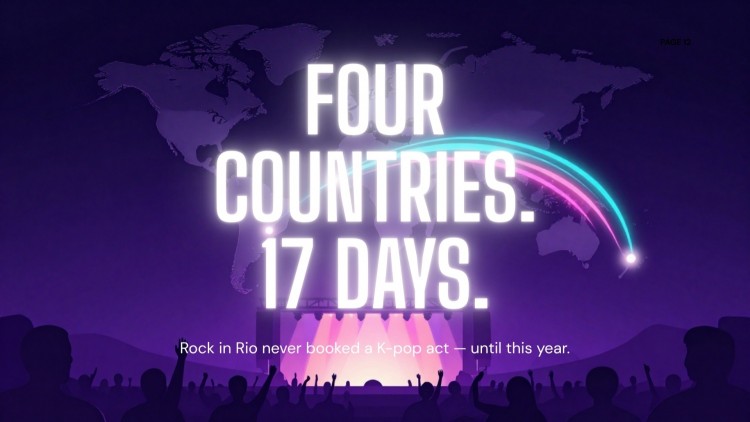
For 40 years, Rock in Rio's main stage went to rock royalty - Queen, Guns N' Roses, Metallica, Foo Fighters. On Sept. 11, it goes to Stray Kids, the first K-pop act the festival has ever booked in any capacity, let alone as a headliner. The show sold out within an hour of presale in June. It sits in the middle of a run that also includes Bogotá, Buenos Aires and Mexico City - a four-country swing JYP Entertainment didn't build as a tour leg, but as its own branded festival series, STRAYCITY.
That distinction is the argument. Latin America used to be where K-pop groups added a stop if the schedule allowed it. It's now a market shaping how the tours themselves get built - evidenced by a label choosing to invent a standalone festival format for the region rather than bolt four cities onto an existing world tour, and by a 40-year-old Brazilian institution handing its main stage to a Korean group for the first time in its history.
STRAYCITY isn't styled as a tour. It has its own name, its own city-specific guest lineups - NEXZ at every stop, Bad Milk and Kei Linch added in Bogotá, K4OS and Cocho in Buenos Aires, Andrés Obregón and RENEE in Mexico City - and marketing language borrowed from festival branding rather than concert-tour branding. JYP's Live Nation partners describe it as "a shared space for music, energy and self-expression," the kind of language usually reserved for a Lollapalooza or Rock in Rio, not a four-stop arena run. The format itself is the signal: this is a region getting purpose-built content, not leftover tour dates.
Rio de Janeiro proves that most directly. Rock in Rio has run since 1985 and hosted essentially every major global rock act that toured in the past four decades. Stray Kids headlining the Sept. 11 slot - the same bill that includes Elton John, Foo Fighters and Twenty One Pilots across the festival's two weekends - makes them the first K-pop act to appear on the festival in any role, not just the first to headline it. The festival's own announcement leaned into the framing directly: "For the first time in history, K-pop comes to Rock City," it posted. "The beat that conquered the planet will echo on the World Stage." That's a 40-year-old festival's own language, not a K-pop label's press release.
The commercial pattern backs up the framing. Bogotá and Buenos Aires are both first-ever Stray Kids shows in their countries - a gap that's notable given the group already played Chile, Brazil, Peru and Mexico during 2025's "dominATE" tour and skipped both Colombia and Argentina entirely. Mexico City needed a second date within hours of the first going on sale; both are now sold out. Rock in Rio sold out in under 60 minutes during its presale window in June, months ahead of the show. None of that reads like a market being tested. It reads like a market the label already knew would sell out, and structured a standalone series to capture rather than a single arena stop.
The macro numbers explain why. The IFPI's Global Music Report for 2026 found Latin America was the fastest-growing region for recorded music in 2025, with revenue up 17.1% year-over-year - well ahead of the global average. Brazil now ranks as the world's eighth-largest recorded-music market, Mexico tenth. Streaming accounts for 88.1% of the region's recorded music revenue, meaning the audience that made Stray Kids' Spotify and YouTube numbers climb in Bogotá and Buenos Aires was already there before any tour stop was ever booked.
American readers have already watched a version of this play out in their own market. The RIAA reported Latin music wholesale revenue in the U.S. hit $490.3 million in the first half of 2025 alone, up 5.9% year-over-year - more than six times the growth rate of the overall American market, and the twelfth straight year of mid-year growth for the genre. Latin music didn't arrive in the American mainstream through one big tour date; it arrived through years of streaming growth that eventually forced festivals, labels and stadiums to build around it rather than around a single artist's calendar. Rock in Rio booking Stray Kids reads as the same mechanism, one genre and one region removed.
Not everything about the region's K-pop expansion has moved at the same pace. Chile, Brazil, Peru and Mexico got Stray Kids stadium shows in 2025. Colombia and Argentina - two of the region's larger music markets - waited until September 2026 for a first visit from the same group, and it took a purpose-built festival format rather than a standard tour stop to get them there. The growth the IFPI numbers describe is regional, but the infrastructure that turns streaming numbers into concert dates is still arriving unevenly, market by market, tour cycle by tour cycle.
What happens after September is the open question. STRAYCITY is, so far, a Stray Kids project - built around one group's specific popularity and JYP's specific festival partnerships with Live Nation across four countries. Whether other agencies follow with their own standalone Latin America formats, or whether this stays a one-group experiment tied to a single record-breaking run, isn't something September's ticket sales will answer. Rock in Rio has only confirmed one K-pop headliner so far. Whether it books a second is the next data point, not this one.


