

The Assassin(s) Controversy: Yuk Young-soo Film Facts


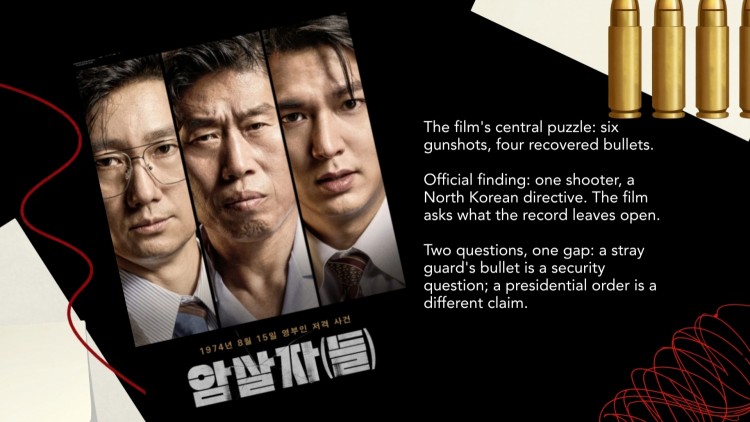
The film's central puzzle is arithmetic: six gunshots, four recovered bullets. Hur Jin-ho's The Assassin(s) builds a mystery thriller on that gap, set at the Aug. 15, 1974 Liberation Day ceremony where First Lady Yuk Young-soo was killed. Since its Sept. 23 release in Korea it had sold about 1.63 million tickets by Sept. 28, according to the Korea Times, and it has drawn a police complaint, calls for an injunction, and boycott lists that now include actors.
This article argues that the film's weakness is evidentiary, not political. Its makers say they used publicly available records and added only imagination. A film that adds no new document has no basis for pointing an audience toward the president who was sitting next to his wife when she was shot, and pointing is what its critics say it does.
The official record is not vague. Mun Se-gwang, a Korean resident of Japan, fired at Park Chung-hee from the audience; investigators concluded he acted on a North Korean directive. The shooting missed the president and killed his wife, who was 48. Mun was executed on Dec. 20, 1974. Sidae reports that he left last words apologizing to Park and to Yuk; that account comes from secondary sources and should carry a qualifier.
The film starts from a different place. It follows a police superintendent played by Yoo Hae-jin, a newspaper editor played by Park Hae-il, and a rookie reporter played by Lee Min-ho as they test the government's findings. It references the 1973 abduction of Kim Dae-jung. The Korea JoongAng Daily reads the film as suggesting the Korean Central Intelligence Agency orchestrated the shooting and that Park may have engineered it to reverse his political troubles. The Korea Times reads it more narrowly, as hinting at official complicity without an explicit accusation. Both readings agree on the direction of the hint.
The producers reject the second half of that. Their statement says the film "does not designate a specific individual as the mastermind," "does not present its hypotheses or dramatic settings as historical fact," and does not try to prove a new historical conclusion, "nor does it deny or distort known facts." Former Seoul city councilor Lee Jong-bae, who filed a defamation complaint against Hur, Hive Media CEO Kim Won-guk and writers Kwon Gi-jun and Lee Ji-min, points at the title. The plural in Assassin(s), he argues, is the accusation. It is his reading of a parenthesis, and the police will have to decide whether it holds.
The bullet question deserves a straight answer, because it is the film's best card. The possibility that a guard's bullet struck Yuk has circulated in Korea since 2005, after diplomatic documents were released and SBS aired a report on it. Film critic Lee Dong-jin has asked, of the discrepancy between the official four bullets and the film's gunshots, where the rest came from. That is a legitimate question about a security failure at a chaotic ceremony. It is a different proposition from the claim that the man beside her ordered it, and nothing cited in the film's defense connects the two. The distance between "a guard's bullet may have hit her" and "her husband may have arranged it" is where the film's suspicion does its work, and the makers have supplied nothing to cross it.
Americans have watched this argument before. Oliver Stone's JFK put a conspiracy on screen in 1991 against the Warren Commission's finding, and Congress answered in 1992 with a law requiring the release of the government's assassination records. The response to a film's insinuation was more documents. In Seoul, the response so far has been a criminal complaint, a possible injunction petition from the Park Chung Hee Memorial Foundation and the Yook Young Foundation, and lists of actors to shun. Legal scholars are split on whether the criminal complaint can succeed, according to Sidae. Democratic Party Rep. Choi Min-hee asked the obvious defense: "Isn't filmmaking about creating works of fiction based on historical facts?" It is. A 2005 film, The President's Last Bang, faced a similar court challenge from Park's son, Park Ji-man.
Conservatives read the film as one move in a larger campaign. People Power Party leader Jang Dong-hyeok said the left "makes films like this," Rep. Joo Jin-woo called it a crime against the bereaved and argued it hides that the shooting was North Korea's work, and Rep. Yoo Young-ha, a close ally of Park Geun-hye, called it "clear political propaganda," according to Seoul Shinmun and Korea Daily. Conservative commentators add a question about timing: why a 1974 mystery now, when Park's record is being reassessed and the Oct. 26 anniversary of his 1979 assassination is weeks away, and what new document justified it. The second half of that question is the strongest point in the pattern argument, and the makers' own statement answers it against themselves: public records only. The first half, that the film was made to block that reassessment, is an inference about intent. Hur said he set out to make a mystery that follows the questions left by the 1974 investigation, and the producers deny political purpose. Hive Media also denied rumors of Chinese funding, saying it used only domestic capital. Nothing published so far shows what the filmmakers intended beyond their own statements, so the pattern stays an argument made by named critics and not a finding.
The North Korea question is where the argument is loudest and the evidence thinnest. People Power Party lawmaker Park Chung-kwon called the film a "Korean version of a North Korean film." Han Song-i, a defector and YouTuber, said it resembled the North's serialized propaganda film Nation and Destiny, and that it was "exactly the same" as what she saw in the North. In the coverage reviewed, she did not compare specific scenes. An anonymous forum post describes a scene in which a KCIA chief or presidential security chief shoots Yuk from behind the stage while Mun fires from the front, and it names no source. That is a claim that can be tested by watching two films side by side. No side-by-side comparison has been published, and none of the producers' statements reviewed for this article says whether they watched Nation and Destiny.
The strongest rebuttal circulating is also the weakest. PPP leader Jang Dong-hyeok and others have said Kim Jong-il apologized directly in 2002 to Park Geun-hye, then a party leader visiting Pyongyang, for the killing. OhmyNews reports that the apology Park has cited publicly concerned the 1968 Blue House raid led by Kim Shin-jo, and that a Japanese wire report of a broader remark was denied by her side. A rebuttal built on a disputed apology hands the film's defenders an easy correction. The record needs no help: the 1974 investigation pointed north.
A film that says it names no one has 1.63 million tickets sold and a police file open on it. The question the makers have not answered is the one their critics have put in front of them: whether they watched Nation and Destiny before they wrote their film.


