

Stray Kids Just Tied the Rolling Stones on the Billboard 200. Almost None of the Credit Belongs to Streaming.


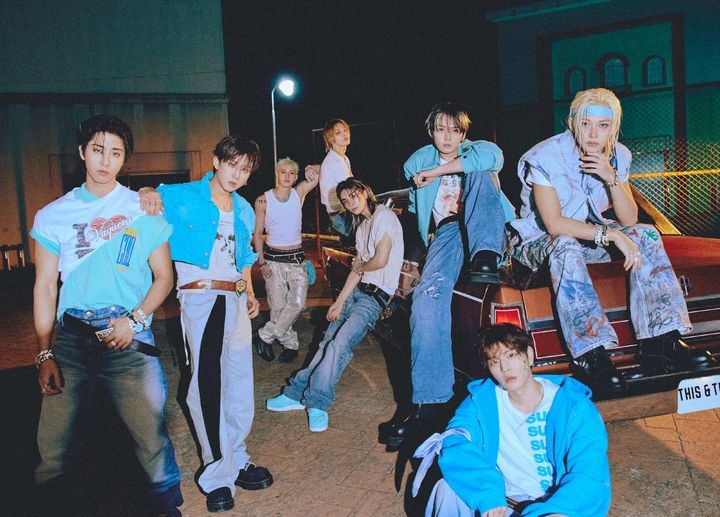
Stray Kids' ninth album sold 357,000 physical copies in the United States in a single week. On-demand streaming accounted for 11,000 units - about 3 percent of the total. In an industry that has spent a decade telling itself the album is dead and the stream is everything, the group that just tied the Rolling Stones for the second-most No. 1 albums by any group in Billboard 200 history did it almost entirely on plastic.
"THIS & THAT" debuted atop the chart dated August 22, earning 369,000 equivalent album units in the tracking week ending August 13, according to Luminate. It is Stray Kids' ninth Billboard 200 entry, and the ninth to open at No. 1 - a run that started with "ODDINARY" in 2022 and makes the group the first act in the chart's 70-year history to send its first nine releases straight to the top. The nine No. 1s tie Stray Kids with the Rolling Stones among groups, trailing only the Beatles' 19, and tie them with Taylor Swift for the most No. 1 albums by any act in the 2020s.
The streaming numbers on "THIS & THAT" are, by contrast, unremarkable. Track-equivalent and streaming-equivalent units together came to roughly 12,000 - a fraction of what a comparable Western pop release generates in its own chart-topping week. What put "THIS & THAT" at No. 1 was 17 separate CD and vinyl variants, some carrying randomized photocards, posters and stickers, plus eight digital download variants, all produced in-house by the group's member-producer collective, 3RACHA. Traditional sales alone - 357,000 copies - made it Stray Kids' single biggest sales week ever, and the second-largest sales week logged by any album in 2026, trailing only BTS's "Arirang," which opened with 532,000 in March.
This is not a new mechanism. It is the mechanism, and it long predates this specific album. What's changed is the scale, and the fact that the same purchasing pattern responsible for Stray Kids' Billboard history is now the specific target of environmental scrutiny in Korea.
In April, the Korea Times reported that the country's major K-pop agencies produced a combined 6,667 tons of plastic waste tied to physical album merchandising, built almost entirely on the randomized-variant model. The report singled out Stray Kids' 2024 album "Karma" as a case study: the release moved 3 million copies in its first week across five versions, with its "Ceremony" edition containing 17 separate components per unit - plastic wrapper, paper box, a 112-page photobook, a postcard set, a mini poster, a paper CD case, a sticker and a photocard. JYP Entertainment, Stray Kids' label, pledged in 2021 to shift some exclusive content to digital formats to cut down on the waste. Government figures cited in the same report show the opposite trend industry-wide: SM Entertainment's plastic output rose from roughly 400 tons in 2022 to 647 tons by 2024; HYBE's rose from 729 tons to 1,405 tons over a similar span. An unnamed executive at one of the four major agencies told the paper, "It is not easy to reduce the proportion of plastic records."
The reason it's not easy is the same reason "THIS & THAT" is sitting at No. 1: the variant model doesn't just sell units, it manufactures scarcity and chance in a way streaming can't. Each version is a different chance at a specific photocard. Fan-sign and video-call raffles are tied to purchase volume, not purchase of a specific version, which pushes collectors toward buying in bulk rather than buying the version they actually want. Kpop4Planet, an environmental campaign founded by fans in 2020, collected more than 8,000 unwanted albums earlier this year and delivered them to HYBE, JYP and SM as a physical protest against the practice - using the labels' own products as evidence.
None of this is unique to K-pop, and that's worth sitting with rather than skipping past. Taylor Swift - the artist Stray Kids just tied for most 2020s No. 1s - has built her own chart dominance partly on vinyl and CD variant strategy, releasing "Midnights" and its successors in multiple colorway editions that function the same way a Stray Kids photocard does: a reason to buy the same album twice. The difference is one of degree, not kind. A Swift variant run might mean four or five vinyl colors. A Stray Kids "Ceremony" edition means 17 individually wrapped plastic components times potentially dozens of randomized photocard permutations, multiplied across a fanbase conditioned to treat bulk purchasing as a form of chart participation.
Some of the industry's response has been more substantive than public statements suggest. HYBE's Weverse Album format, introduced in 2022 as an NFC-based digital-physical hybrid, was built specifically to cut packaging - and yet HYBE's total plastic output still grew in the years after its introduction, because Weverse Albums supplemented rather than replaced the traditional CD variant runs that keep chart battles competitive. A Korea Tourism Institute researcher, Yang Ji-hoon, has argued the industry needs "more events linked to waste-free smart albums" rather than digital formats that exist alongside physical ones. So far, no major agency has tied fan-sign or raffle access exclusively to a low-waste format, which is the one change that would actually shift purchasing behavior rather than add another SKU to it.
Stray Kids' next benchmark is one away: a tenth No. 1 would break the tie with the Rolling Stones outright and leave the group second only to the Beatles among any act, group or solo, in Billboard 200 history. Getting there will not require a hit single in the traditional sense, or even much additional streaming traction. It will require another set of variant editions, another randomized photocard drop, and a fanbase willing to buy the same eight tracks in enough different plastic wrappers to get there. Judging by the last nine albums, that has never been in doubt.


