

South Korea Promised a 50,000-Seat K-Pop Dome. Eight Months Later, It Still Can't Say Where.


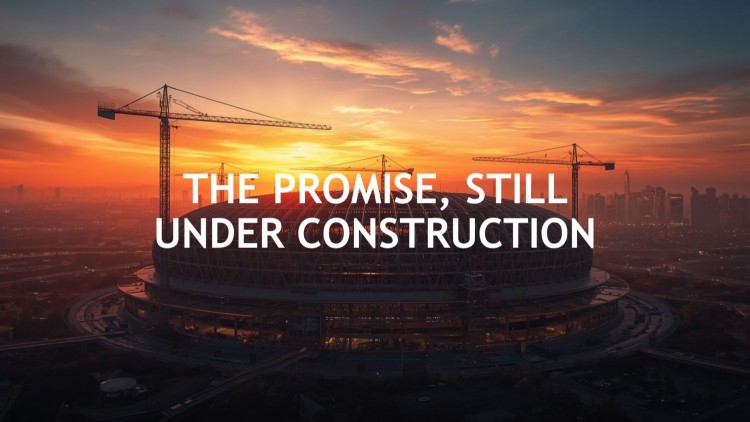
In December, South Korea's culture minister stood in Sejong and promised a domed arena built for K-pop: 50,000 seats, a timeline of 2027 or 2028, and a stated purpose of anchoring the country's global concert business. On Wednesday, the same ministry told President Lee Jae Myung it had narrowed the project down to two possible sites - and still hadn't picked one. The feasibility study's contractor was only selected in April. Bidding criteria haven't been finalized. The confident number from December has softened into a range: "30,000 to 50,000 seats."
Set next to that slippage is a tourism target the government keeps beating ahead of schedule. Korea expects 23 million foreign visitors this year, after arrivals rose 21% in the first half of 2026 - enough that the Culture Ministry now expects to hit its long-standing goal of 30 million annual visitors a full year early, and has already set a new target of 40 million beyond that. The two halves of Wednesday's briefing tell almost opposite stories: the number Korea is chasing keeps arriving faster than promised, while the venue meant to help hold onto that momentum keeps arriving slower.
What December Actually Promised
The dome wasn't a new idea in December - Seoul has been short on large concert venues for years - but the language around it was firmer than anything since. Culture Minister Chae Hwi-young described a 50,000-seat facility as critical infrastructure for staging global K-pop tours, floated a completion window of 2027 to 2028, and said the ministry would keep pushing K-pop's international reach so the dome would have an audience worthy of it by the time it opened. That was a specific number, attached to a specific window, from a minister explaining why the project mattered.
By Wednesday, the specificity had gone the other direction. Officials now say a dome that size "cannot be filled by concerts alone" and must double as a sports venue - a rationale that wasn't part of the December pitch, when the dome was framed as K-pop infrastructure first. They've also ruled out building more than one or two nationwide. None of that is necessarily bad planning. It's a more conservative plan than the one the country was sold eight months ago, arrived at through the ordinary friction of feasibility studies and site selection. But it is a smaller, slower, more hedged version of the same promise - and the ministry hasn't described it as a change in ambition so much as a continuation of the same one, just further along.
The Gap the Dome Is Supposed to Close
Korea's concert business has a real venue problem, and it's not a hypothetical one dreamed up to justify a stadium. The KSPO Dome and the World Cup Stadium - the two venues most often pressed into service for arena-scale K-pop shows in Seoul - get used for concerts only occasionally, because they were built for other purposes and have to be booked around them. Industry estimates put Korea's concert market at roughly $1.7 billion, driven partly by international acts increasingly routing Asia tours through Seoul rather than treating it as a secondary stop. Every act that can't get a date, or has to scale down a show because nothing bigger is available, is lost ticket revenue, lost hotel nights and lost tax receipts - the exact kind of thing a Culture Ministry trying to hit a tourism number ought to care about closing.
That's the case for building the dome quickly. It's a weaker case for building it only once or twice, capped at 50,000 seats, shared with sports events that have their own scheduling needs. If the venue crunch is as real as the industry data suggests, a single dome - however large - resolves a fraction of it. The ministry's own framing, that one dome can't be filled by concerts alone, is itself an admission that K-pop's touring economy, as large as it's become, still isn't quite large enough on its own to justify dedicating a stadium-scale building to it outright.
A Familiar Shape, From a Different Country
None of this should read as uniquely Korean government sluggishness. The pattern - a splashy number and a firm date, followed months later by a narrower, slower, more qualified version of the same plan - is the same one American readers have watched play out with the Sphere in Las Vegas, which took years longer and hundreds of millions of dollars more than its original pitch suggested, or with any of a dozen U.S. stadium projects sold to the public as economic engines before construction timelines and budgets started slipping. The difference here is what's arriving on schedule instead: it's usually the venue that arrives late and the demand projections that don't hold up. In Korea's case, the demand curve is the one outperforming, while the building is the one sliding.
What's Actually Being Bet On
The rest of Wednesday's briefing was the tourism ministry doing what it does when the infrastructure isn't ready yet: selling the destination anyway. Officials described 110 travel routes and 444 sites tied to K-pop concerts and K-drama filming locations, marketed directly to inbound visitors as "content tourism" - a way of monetizing the demand that already exists without waiting for a dome to be built to house it. A "golden route" linking five regional airports is meant to pull visitors past Seoul into markets that don't have a concert-venue problem because they don't have concert venues at all yet.
Chae's December comment - that Korean culture would likely be even more popular by the time the dome opens - was meant as reassurance. Read next to Wednesday's still-unpicked site and still-unfinished feasibility study, it reads more like a hedge the ministry is making on its own behalf: betting that global demand for K-pop will keep outrunning Korea's ability to build for it, for exactly as long as it takes to finish deciding where to put the building.


