

South Korea's Election Inquiry Opened Tuesday. Seven of Eight Commissioners Didn't Show Up.


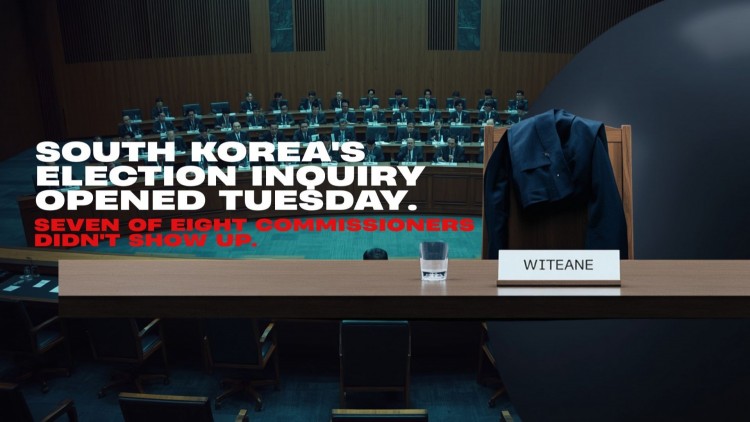
The parliamentary special committee on South Korea's ballot shortage crisis held its first formal hearing on Tuesday. Forty-three witnesses had been summoned - 27 of them current or former officials of the National Election Commission. Of the NEC's eight sitting commissioners, one appeared. The other seven did not.
Wi Chul-hwan, the NEC's acting chairman since former chief Roh Tae-ak resigned on June 5, sat alone before the committee and apologized. "I offer my sincere apologies to the voters who experienced significant confusion and inconvenience while exercising their precious right to vote, which should have been guaranteed," Wi said. He pledged to cooperate fully and declined lawmakers' calls for his own resignation, saying it would be "irresponsible" to step down now. The seven absent commissioners offered no public explanation for their non-appearance.
Lawmakers from both the ruling Democratic Party and the opposition People Power Party called the absences a "collective act of defiance." The committee - 18 members, a 250-to-1 parliamentary mandate, a 45-day investigative window ending August 1 - urged the missing witnesses to appear before its next session. Committee chair Yoon Sang-hyun, a PPP lawmaker, said the panel would use all available legal tools to compel attendance.
What the Investigation Has Established
The factual record of the June 3 ballot shortage has grown significantly in the three weeks since election day. The National Election Commission printed ballots for approximately 50 percent of registered voters at each polling station - a standard it had quietly lowered from 60 percent in December 2025, a decision made by the commission's secretary general and election policy bureau head without a formal internal review process, according to Chosun Ilbo reporting confirmed by NEC data.
The result: 91 polling stations ran short nationwide, up from the NEC's initial acknowledgment of 51. At 26 stations, voting was temporarily suspended entirely. At some stations in Songpa-gu, Seoul - a historically conservative district - voters waited in line past the official 6 p.m. closing time while emergency ballot supplies were in transit; exit poll results had already been broadcast by the time those voters cast their ballots, raising questions about the integrity of the secret ballot process under Korean election law.
The investigation has also surfaced three additional irregularities beyond the shortage itself. First, SBS reported that 70.2 percent of the 24,577 emergency ballots dispatched to polling stations on election day lacked pre-printed serial numbers - meaning election workers had to hand-write numbers, adding delays to an already degraded situation. Second, KBS reported a data entry error in North Jeolla Province's education superintendent election in which vote counts from one polling station were entered under a different station's name; the NEC discovered the error on June 4 and said it did not affect the outcome, though that determination was made by the same institution under investigation. Third, a ballot storage box sought as evidence was reportedly disposed of before investigators could examine it - the box, labeled with a ballot count of 1,900 for a constituency with 4,178 registered voters, would have been direct physical evidence of whether the 50-percent standard was met.
The Structural Problem the Hearing Exposed
The seven commissioners who didn't appear on Tuesday represent something beyond individual non-compliance. The NEC is a constitutional body with limited external oversight - its commissioners serve fixed terms and cannot be removed by the executive branch. That design, intended to guarantee independence from political pressure, has created an institution with few mechanisms for compelled accountability. The parliamentary committee can issue summons. It cannot, under current law, arrest commissioners who ignore them.
That gap is precisely what PPP chair Jang Dong-hyeok has been arguing requires a special counsel - an independent prosecutor whose authority sits outside both the NEC's constitutional protections and the executive branch's investigative chain. The joint police-prosecutor team currently leading the criminal probe reports ultimately to institutions under President Lee Jae-myung's administration, the same administration that won most June 3 local races. The Democratic Party, which holds a parliamentary majority and whose cooperation would be required to establish a special counsel, has not committed to the proposal.
The rerun question has entered a new legal phase. Wednesday was the statutory deadline for petitions challenging the June 3 results; the PPP and Reform Party filed petitions in multiple jurisdictions before the cutoff. Under South Korean election law, if investigators find irregularities within 60 days of those petitions - by approximately August 22 - the cases go to court to determine whether affected races must be rerun. The NEC maintains that the shortages do not meet the legal standard for invalidation. No court has ruled either way.
The Protest That Won't End
Outside the SK Olympic Handball Gymnasium in Seoul's Songpa district - the ballot counting center that protesters blockaded beginning June 5 - demonstrations entered their 20th consecutive day on Monday. Seoul city government estimates placed the Sunday crowd at 34,000 people, the largest since the protests began, with participants in their 20s and 30s accounting for more than half of those present. The protesters are not uniformly aligned with the organized right. Survey data and on-the-ground reporting from Seoul Economic Daily have consistently shown a cross-generational, politically mixed crowd whose central demand is not a specific electoral outcome but an answer to a specific question: how does a ballot shortage happen in 91 polling stations in one of the world's most administratively sophisticated democracies, and who decided to lower the printing standard six months before the election without a formal review?
The seven commissioners who skipped Tuesday's hearing did not answer that question. The committee has until August 1 to get one.


