

University Student's Pointed Questions About North Korean Newspaper Access Ignite National Debate on Constitutional Principles


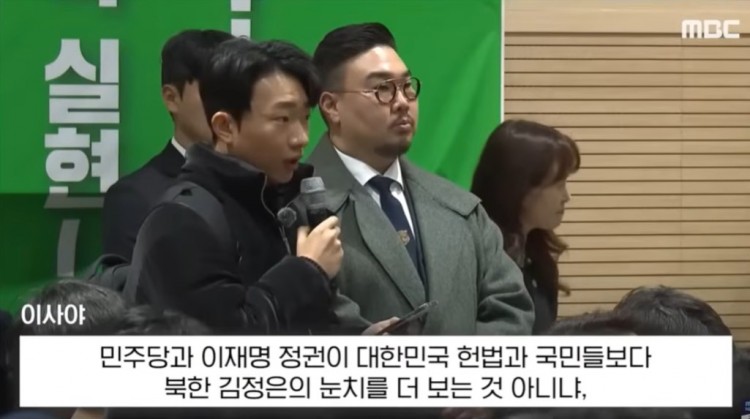
A 27-year-old university student, Lee Sa-ya, has sparked intense public discourse after directly challenging high-ranking government officials over the administration's policy enabling public access to North Korea's state-run newspaper, the Rodong Sinmun. The incident, which unfolded during a public event at Chonbuk National University, has brought into sharp focus questions about the government's adherence to liberal democratic constitutional principles and its approach to materials from a hostile state.
Public Confrontation Raises Constitutional Questions
Lee Sa-ya, a student at Chonbuk National University, attended a local event hosted by the Junior Chamber International (JCI), which featured Deputy Prime Minister Kim Min-seok and drew approximately 500 attendees including Democratic Party officials. Despite significant security presence, Lee secured an opportunity to speak during the question-and-answer session.
During his remarks, Lee posed direct questions regarding what he characterized as the administration's accommodating posture toward North Korea and China. He specifically questioned the rationale behind the Lee Jae-myung government's decision to facilitate access to the Rodong Sinmun using public resources, characterizing such actions as potentially constituting "acts benefiting the enemy" (ijeok-haengwi).
His central concern focused on whether these policy decisions demonstrate proper respect for the liberal democratic constitutional order-a fundamental principle enshrined in South Korea's constitution that explicitly rejects totalitarian ideologies and hostile propaganda from North Korea.
Dispute Over Resource Allocation and Terminology
In response to the inquiry, administration representatives and supporters, including President Lee Jae-myung, characterized the student's claims as "fake news." Officials argued that the newspaper was merely "reorganized" or made accessible through existing public archives rather than being actively "distributed" with dedicated new funding.
However, in a subsequent interview with YouTube channel "GROUND C," Lee Sa-ya challenged this semantic distinction. He contended that the administrative costs, personnel time, and procedural resources required to facilitate easier public access to what he termed "enemy propaganda" necessarily involve the deployment of national resources. "By lowering barriers for citizens to access propaganda from a hostile state that explicitly seeks our system's destruction, the government is materially aiding that state's objectives," Lee argued.
This raises substantive questions about whether administrative facilitation of access to materials from a regime constitutionally defined as hostile represents a departure from the state's fundamental obligation to protect its constitutional order.
Allegations of Inconsistent Standards
Beyond specific policy concerns, Lee Sa-ya highlighted what he perceives as inconsistencies in the Democratic Party leadership's approach to political discourse. While party leaders frequently characterize their critics as "extreme right-wing" or accuse them of "hate speech," Lee pointed to the historical records of senior officials, including Kim Min-seok's documented involvement in the occupation of the U.S. Cultural Center and participation in confrontational protest movements.
Lee further referenced President Lee Jae-myung's well-documented verbal confrontation with a family member, which became a matter of public record, questioning how such conduct aligns with the administration's professed standards for civil discourse.
Online Backlash and Unwavering Position
Following the confrontation, which received coverage from major outlets including MBC and prompted direct social media response from President Lee Jae-myung, Lee Sa-ya has faced considerable online criticism. He reports receiving numerous negative comments on his social media accounts and symbolic "18-won" bank transfers-a form of political expression in Korean online culture-accompanied by critical messages.
Despite this response, Lee has maintained his position. In a statement directed at the administration, he declared, "So what? (Eojjeolagu?)" He emphasized that if government actions genuinely raise questions about benefit to a constitutionally-defined enemy state, it remains both the right and responsibility of citizens to pose such questions.
Constitutional Principles at Stake
The incident has crystallized broader concerns about the administration's commitment to foundational constitutional principles. South Korea's constitution explicitly establishes a liberal democratic order and designates North Korea's totalitarian system as fundamentally incompatible with that order. The constitutional framework obligates the state to protect against ideological subversion and propaganda from hostile entities.
When a government facilitates easier access to official propaganda from a regime that constitutionally threatens the nation's fundamental order-regardless of the stated archival or academic justifications-it raises legitimate questions about whether such actions serve the constitution's protective intent or undermine it.
This is not merely a matter of policy preference but touches on the government's core constitutional duty. The administration's dismissal of these concerns as "fake news" rather than engaging with the substantive constitutional questions may itself indicate a troubling lack of seriousness about these foundational principles.
Youth Voices and Democratic Accountability
The confrontation represents more than an isolated incident. It reflects growing willingness among segments of South Korea's younger generation to directly challenge policies they view as incompatible with constitutional principles, regardless of potential personal consequences.
Lee Sa-ya's questioning-whether one agrees with his characterization or not-exemplifies the type of bold civic engagement that democracies require to maintain accountability. The response he has received, both from officials who deflect rather than address constitutional concerns and from online supporters who resort to harassment rather than reasoned debate, raises its own questions about the health of democratic discourse.
Broader Implications
As this debate continues, the central question remains unanswered: How does facilitating public access to propaganda materials from a constitutionally-defined hostile state serve the nation's commitment to its liberal democratic constitutional order?
The administration has yet to provide a compelling explanation that addresses this fundamental constitutional concern. Until it does, questions about whether such policies represent a drift away from constitutional principles-intentional or otherwise-will persist.
Democratic governance requires that leaders not only refrain from actions that benefit enemies of the constitutional order but also demonstrate through their policies an unwavering commitment to the principles that define the nation's identity. When citizens question whether policies meet this standard, they deserve substantive answers, not dismissive rhetoric.


