

The Assassin(s) Distorts 1974 History Yet Tops Box Office


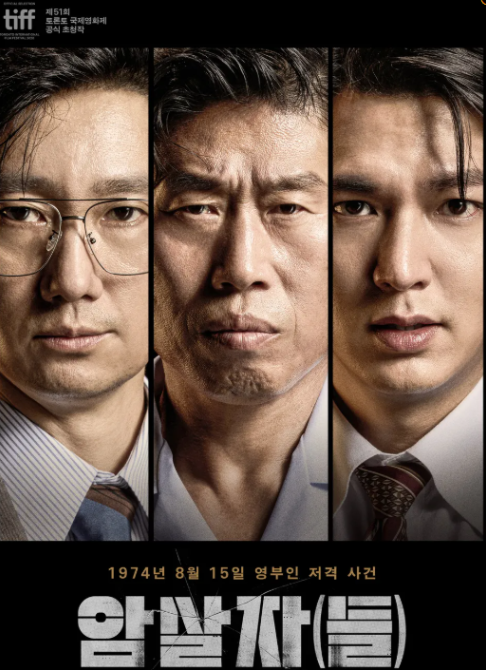
A thriller that recasts the killing of First Lady Yuk Young-soo as an open mystery pointing toward Seoul, not Pyongyang, was South Korea's No. 1 film over the Chuseok holiday.
Hur Jin-ho's The Assassin(s), released Sept. 23 by Hive Media Corp., drew 1.407 million viewers over the four-day holiday, Herald Business reported. On Sunday it took 260,545 admissions for a cumulative 1,566,222, according to box-office figures cited by Hankyung. Tazza: Beelzebub's Song was second with 169,899.
The film reconstructs Aug. 15, 1974, when gunman Mun Se-gwang fired at a Liberation Day ceremony and killed Yuk. The record on that day is not thin. Investigators concluded within two days that Mun acted on North Korean orders, and the Supreme Court confirmed the finding in December 1974, Sidae reported. Mun left a deathbed statement saying he had been "deceived by the organization."
North Korea's own response was a deflection. Incheon Ilbo, citing Kim Il-sung's remarks to the Soviet ambassador in October 1974, reported that he claimed Mun belonged to leftist elements of Mindan who supported Kim Dae-jung, a claim that contradicted South Korea's investigation.
Hur's film goes the other way. It highlights that six shots were fired but only four bullets were recovered, and asks how the gunman got past security, Sidae reported. It suggests domestic power figures may have been involved. The producers call it a mystery thriller built on artistic interpretation.
The Park Chung-hee Presidential Foundation called it a distortion of a historical tragedy and demanded an apology and an end to screenings. People Power Party spokesman Park Sung-hoon called it "historical distortion and incitement." Lawmaker Joo Jin-woo said it depicts President Park, not North Korea, as the true perpetrator, and called that an "unfilial crime." Lawmaker Yoo Young-ha said it cunningly twists the facts. Broadcaster Hong Hye-kyul called it a desecration of a man respected by half the country, made while survivors are alive.
PPP leader Jang Dong-hyuk cited Kim Jong-il's 2002 apology and asked on Facebook whether freedom of expression is reserved for the left. The 2002 episode is itself contested. Incheon Ilbo and Sidae report that Kim told a South Korean visitor, Park Geun-hye, in May 2002 that lower-level officials were involved and that he had no advance knowledge. OhmyNews, however, reports that Park's own later accounts cite only an apology for the 1968 Kim Shin-jo raid, and that her office denied a Japanese wire report of a remark about her mother. Either way, the court findings do not depend on it.
Hive Media's statement says the film is "a fiction film reconstructed by adding cinematic imagination based on various historical records," and that it "does not establish any specific person as the incident's mastermind, nor present fictional hypotheses as historical fact." It added that there was no political purpose. Hur said he was examining the "doubts and limitations" of the record.
That defense does not hold. A film need not name a culprit to plant one. Counting bullets and lingering on security lapses, against a Supreme Court ruling and a killer's own deathbed statement, steers 1.5 million viewers toward a conclusion the record rejects, and it is the same direction Pyongyang tried to point in 1974. Legal experts are split on whether it amounts to defamation, Sidae reported.
The producers' statement offered no apology and no change to the film's run. It was still No. 1 on Sunday.


