

The Switzerland Talks Ended. The US and Iran Can't Agree on What Was Agreed.


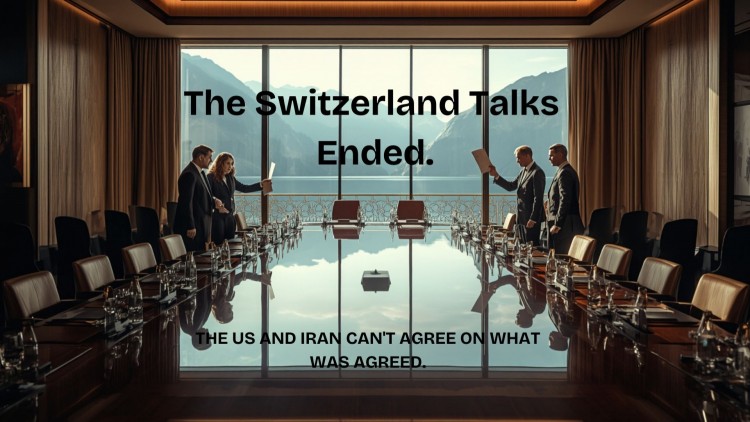
JD Vance left Switzerland on Monday after what he called "a productive 36 hours." The first round of technical negotiations between the United States and Iran had wrapped. "I feel great about the progress that we made," he told reporters before boarding Air Force Two at Emmen Military Air Base. Iran's deputy foreign minister, Kazem Gharibabadi, said the talks had been productive in establishing terms for the next round.
The agreement on what was agreed ends there.
Vance said Iran had agreed to allow International Atomic Energy Agency inspectors back into Iranian nuclear facilities - a central US demand since the MOU was signed June 17. Iran said it had made no such commitment. "The IAEA visit will happen only after the final agreement," Iranian officials told state media. Trump, posting to Truth Social after the talks concluded, wrote that "Everybody is fully aware that Iran will agree to have Major Weapons Inspections in order to ensure 'Nuclear Honesty' long into the future" - a formulation that states expectation rather than documented commitment, and that Iran has publicly disputed.
The second dispute emerged from the Iranian side. Parliament speaker Mohammed Bagher Ghalibaf announced that the parties had agreed to release approximately $12 billion in frozen Iranian assets. The Trump administration pushed back immediately, with Vance telling reporters that any future asset release would be "tightly controlled and directed toward purchases that benefit American farmers" - a description that implies conditions Iran has not publicly accepted.
What the 36 Hours Produced
Stripping away the dueling claims, the Switzerland talks generated three documented outcomes. Iran agreed to establish a telephone hotline to "prevent and resolve any misunderstandings" with the United States and other countries as vessels transit the Strait of Hormuz - a concrete confidence-building measure that addresses the core operational risk of the past week. Traffic through the strait has increased since the MOU signing: CNN reported two dozen commercial vessels transited in a single 24-hour period, though the pre-war average was approximately 110 per day. The United Nations International Maritime Organization separately began an evacuation operation to move 11,000 crew members stranded on ships in the Persian Gulf since the strait's February closure. Both developments suggest the strait is functionally reopening regardless of Iran's formal closure declaration.
The US and Iran also agreed that technical negotiations will continue. A second round is expected in the coming days. The 60-day MOU clock, which began June 18, has now consumed nearly a week with no binding nuclear agreement in place.
The Senate Vote
On the same day talks concluded in Switzerland, the US Senate passed a war powers resolution rebuking the Trump administration's decision to conduct military operations against Iran without congressional authorization. The vote passed 51-48, with three Republican senators joining Democrats. It is the first time the Senate has approved such a resolution against a sitting Republican president. The White House said Trump would veto it.
The vote's practical effect is limited - a veto override would require 67 Senate votes - but its symbolic weight is significant. Congressional Republicans who supported the Iran strikes are now running out of cover from an administration whose Iran policy changes faster than any single position can be defended. Senators who voted yes cited both constitutional principle and specific concerns about the administration claiming broader authority than the Authorization for Use of Military Force provides.
Lebanon, Still Burning
The talks in Switzerland took place against an ongoing backdrop of Israeli strikes in Lebanon that Iran has cited as its primary justification for every escalatory move since the MOU was signed. The US brokered a fresh round of Israel-Lebanon talks beginning Tuesday, led by State Department counselor Dan Holler, aimed at moving toward what officials described as a "comprehensive peace and security agreement between the two sovereign states." Netanyahu, speaking Monday, said Israeli forces would retain authority to strike threats in southern Lebanon and would remain in a security zone along the border "for as long as necessary."
The structural problem that has defined this negotiation from the beginning has not changed. Iran signed the MOU. Israel did not. Every Israeli strike in Lebanon gives Iran a pretext to escalate, and the United States cannot compel Israel to stop without threatening the political foundation of the alliance. Vance in Switzerland acknowledged the difficulty directly: "We want Israel's security to be protected, and we also want Lebanon's sovereignty to be protected. And this is going to be an ongoing conversation."
An ongoing conversation, in diplomatic language, means the problem is unsolved. The 60-day clock does not stop for ongoing conversations.


