

K-Pop Is Splitting in Two. Girl Groups Got the Club. Boy Groups Got the Stage.


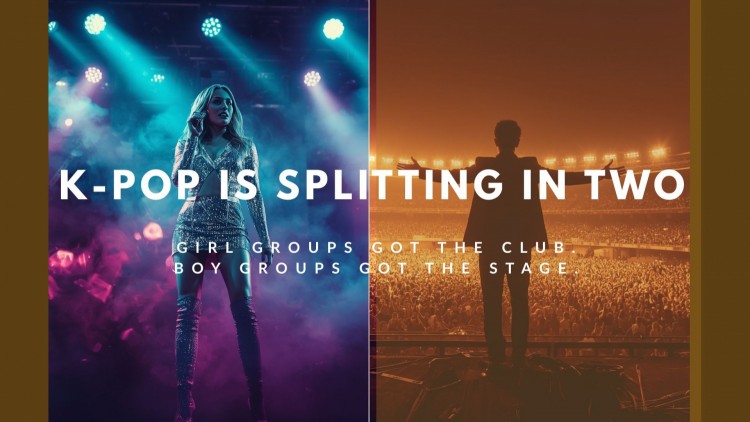
In February, KiiiKiii released "404 (New Era)" - UK house and garage rhythms, a four-on-the-floor kick, the word "404" repeated 39 times across four choruses. It topped Melon's Top 100 chart and swept music broadcast awards. In April, Tomorrow X Together released "Stick With You" - a verse-chorus-bridge arc, layered instrumentation building toward an emotional peak, five music show wins. It reached No. 2 on the Billboard 200. Both tracks succeeded in 2026. They are not the same kind of music. They are not trying to be.
K-pop in 2026 is developing a sound divide along gender lines, and the gap is becoming impossible to ignore. Girl groups are converging on electronic dance music - house, UK garage, techno - with the consistency of a format decision. Boy groups, led by Tomorrow X Together and BoyNextDoor, are moving in the opposite direction: back toward the melodic dance-pop structure that defined the genre in the early 2000s. The divergence is not accidental. It reflects two different theories about how music travels in 2026, and which audiences each camp is trying to reach.
The Girl Group Playbook: Build for the Algorithm
The house music wave among girl groups started with aespa's "Supernova" and Le Sserafim's "Crazy" in 2025 and has not slowed. KiiiKiii's "404 (New Era)" topped Melon in January. IVE's "Bang Bang" - UK hard house, swing-inspired intro, driving straight beat - held the same chart for five consecutive weeks in March. Hearts2Hearts, SM Entertainment's rookie girl group, has built its entire identity around house since debuting in February 2025, with "Style," "Focus," and "Rude!" forming a consistent sonic trilogy. Blackpink's "Jump," co-produced by Diplo and Teddy, went techno. Le Sserafim's next single is described as "hyper techno."
Music critic Lim Hee-yun, speaking to the Korea Herald, identified the structural logic: "House is built on a steady four-on-the-floor beat, which is fundamental to dance music. K-pop is also electronic dance music at its core, so the combination is natural." That's the technical explanation. The strategic one is simpler. A repetitive, groove-driven beat is built for short-form video. "404 (New Era)" works as a 15-second clip the same way it works as a three-minute song because the hook is identical - the beat doesn't need context. House music is not TikTok-optimized by accident. It's TikTok-optimized by design.
The chart results confirm the theory. KiiiKiii's Melon dominance came within weeks of release, driven by streaming volume and music show performance. IVE's five-week run at No. 1 tracked directly with the virality of the "Bang Bang" choreography challenge online. The feedback loop - house beat generates clip, clip generates streams, streams generate chart position - is the girl group playbook in 2026, and it works.
The Boy Group Counter-Move: Build for the Room
Tomorrow X Together's "Stick With You," released in April, opens with acoustic guitar and a restrained vocal. The instrumentation layers. The chorus expands. The bridge drops to a near-whisper before the final lift. It is a song designed to be experienced from beginning to end, in sequence, at volume - preferably in a stadium. "We thought that what might be considered the classic grammar of K-pop - clear narrative progression, performance-focused choreography and songs with distinct emotional highs and lows - could actually feel unique," BoyNextDoor leader Myung Jaehyun said in a press interview earlier this month. He was describing "Viral," his group's title track from their debut studio album Home, which surpassed one million first-week sales. But the same logic applies to TXT.
BoyNextDoor's Home, released June 8, is the clearest statement of the boy group counter-tendency. The production - handled by Pop Time, Kako, and Zico - builds songs with clear verse-chorus-bridge structures, prominent hooks, dramatic bridges, and dance breaks. The Korea Herald described it as evoking "elements of K-pop's earlier dance-pop traditions while maintaining a contemporary sound." What it doesn't do is repeat a single phrase 39 times over a four-on-the-floor beat. It asks for attention span. It rewards the listener who stays.
TXT's 7th Year: A Moment of Stillness in the Thorns takes the same bet further. "Stick With You" peaked at No. 3 on the Circle Digital Chart - the group's first top-five domestic entry - and drove a Billboard 200 No. 2 debut. The domestic chart number matters: melodic dance-pop has historically underperformed on Korean streaming charts relative to house and electronic tracks, where the listen-once-on-a-playlist mechanic favors groove over narrative arc. TXT cracked the top five anyway.
YG's Treasure extended the pattern from a different angle. Their "If I," built around heavy hip-hop beats and raw rap performances, reached 100 million YouTube views within 11 days - a number driven not by chart algorithm but by international fan engagement with a performance-first track.
Why the Split Happened Now
The structural explanation is streaming mechanics. Short-form platforms reward instant comprehension: a track that delivers its entire identity in 15 seconds travels further and faster than one that builds over three minutes. Girl groups, whose fanbases tend to skew younger and more algorithmically active on TikTok and Instagram Reels, have adopted the house and techno format as the path of least resistance to viral reach. The four-on-the-floor beat is a delivery mechanism.
Boy groups, whose international fanbases - particularly in the US, where BTS built the template - have been conditioned by stadium tours and album-length listening sessions, are optimizing for a different metric: retention. A fan who knows "Stick With You" from verse to bridge is a fan who buys a concert ticket. A fan who knows "404 (New Era)" from the choreography clip may or may not show up to a show. The economics of the post-BTS boy group market, where world tours are the primary revenue engine, favor music that translates to live performance.
The US comparison point is not exact, but it is legible. After Taylor Swift's Eras Tour demonstrated that long-form, narrative-structured catalog music drives live revenue at a scale streaming alone cannot, the American music industry began reassessing the trade-off between algorithmic optimization and live-event depth. K-pop's boy group sector appears to be arriving at the same conclusion through a different route - not as a rejection of the algorithm, but as a deliberate decision to build something the algorithm cannot fully contain.
The Limit of the Divide
The split is real, but it is not absolute. RIIZE's "Impossible" uses future house - festival-ready EDM layered over pop melody - and sits closer to the girl group sonic territory than to TXT's melodic arc. BTS's "Swim" incorporates electronic production while maintaining the kind of structural build that works in a 90,000-seat stadium. The divide is a tendency, not a wall.
What it does mark is a moment of genuine genre differentiation within K-pop - a point at which the genre's leading acts are making audible choices about what kind of music they want to make and for whom. Music critic Lim Hee-yun put it plainly: "Rather than recreating sounds of earlier eras, artists are rebuilding familiar K-pop sounds and formulas through modern production techniques, performance styles and visual aesthetics." The girl groups rebuilt the club. The boy groups rebuilt the stage. Both are K-pop. They just aren't the same K-pop anymore.


