

The US and Iran Signed a Deal Three Days Ago. Lebanon Is Already Testing It.


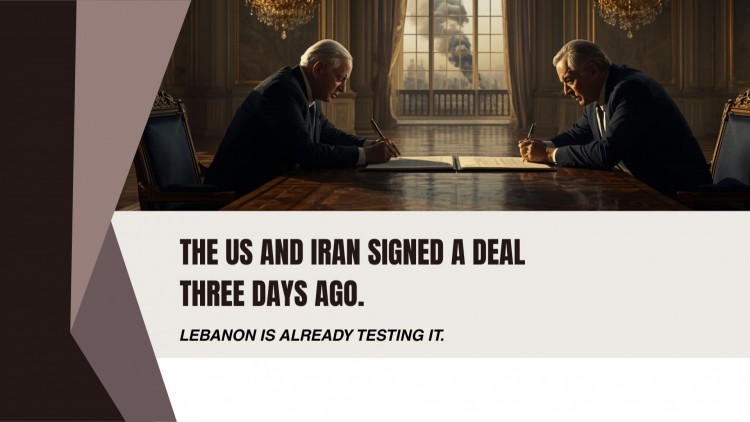
On June 17, Donald Trump and Iranian President Masoud Pezeshkian signed a memorandum of understanding at the Palace of Versailles - not through a formal ceremony, as originally planned, but digitally, during a dinner with French President Emmanuel Macron. Vice President JD Vance confirmed the following day that the 60-day clock toward a final settlement had begun. "I would say the 60-day period officially started today," Vance told reporters on June 18. A signing ceremony had been planned for June 19 in Geneva. It didn't happen. Israel and Hezbollah had exchanged fire the night before.
The MOU ends - for now - a conflict that began on February 28 when the United States and Israel launched coordinated strikes on Iranian nuclear facilities and military infrastructure. More than five weeks of fighting killed thousands in Iran and Lebanon, displaced more than a sixth of Lebanon's population, and disrupted traffic through the Strait of Hormuz long enough to cause fuel shortages across parts of Asia. A preliminary ceasefire held from April 8. The June 17 MOU was supposed to formalize what the ceasefire left unresolved.
What the MOU Actually Says
The 14-point framework, read publicly by a senior US official, covers the immediate and permanent end to all hostilities, removal of the US naval blockade within 30 days, toll-free passage through the Strait of Hormuz for 60 days with demining to follow, and at least $300 billion in reconstruction funding. The United States committed to lifting sanctions on a defined schedule. Iran committed to reopening the strait - which, by the day after signing, was already showing results: commercial shipping traffic through Hormuz surged within 24 hours of the MOU taking effect.
What the MOU does not resolve is the question that started the conflict in the first place: Iran's nuclear program. The framework sets a 60-day window for the two sides to reach agreement on limits to Iran's enrichment capacity and ballistic missile program. Iran reaffirmed its position that it will not seek nuclear weapons - a reaffirmation, not a new concession - while the US committed to lifting sanctions in stages contingent on compliance. The IAEA has not been invited back to Iranian facilities as part of this framework.
The Lebanon Variable
Israel is not a signatory to the MOU. That is the agreement's most consequential structural gap.
Since the US-Iran ceasefire in April, Israel has continued striking Hezbollah targets in Lebanon - a campaign it has maintained is separate from the Iran war, targeting a militia that attacked Israeli forces during the conflict. Iran has consistently argued the attacks violate the spirit of the ceasefire and has made Lebanon's security a condition of any final settlement. On June 19, Israeli strikes on a Hezbollah stronghold near Beirut killed more than a dozen people according to Lebanon's Health Ministry, prompting Iran to warn of "strong responses" and leading US and Iranian officials to postpone the planned Geneva ceremony.
Netanyahu, facing a domestic coalition that has made Lebanon territorial control a political condition for its continued support, approved talks with Lebanon after the Geneva cancellation - a gesture that does not commit Israel to any specific withdrawal timeline. His government has stated that Israeli forces plan to remain "indefinitely" in southern Lebanon.
The US position is that the MOU covers Iran, not Israel's operations in Lebanon. Iran's position is the opposite. The 60-day nuclear negotiation clock is running while this disagreement sits unresolved.
What the 60 Days Look Like
The Hormuz reopening is the MOU's most concrete deliverable, and it is working: tanker tracking data shows commercial traffic returning to pre-conflict levels within days of the signing. The economic pressure that made Iran willing to sign - the shipping disruption had begun to affect Chinese and Indian energy imports, straining relationships Tehran needs - is being released precisely as the diplomatic leverage it provided disappears.
The nuclear talks that follow will be the hardest negotiation the Trump administration has attempted. Iran's position entering the 60 days is that it has already made significant concessions by agreeing to demilitarize the strait. The US position is that the MOU is a framework, not a deal, and that Iran's nuclear program remains the central unresolved issue. Israel, whose strikes triggered the conflict, sits outside the agreement and has given no public indication it will coordinate its Lebanon operations with the MOU's diplomatic timeline.
The Geneva ceremony was meant to signal that the framework was stable enough to celebrate. Its postponement on Day 2 of the 60-day clock signals something else.


