

South Korea's Parliament Just Voted 250-to-1 to Investigate Its Own Election Commission


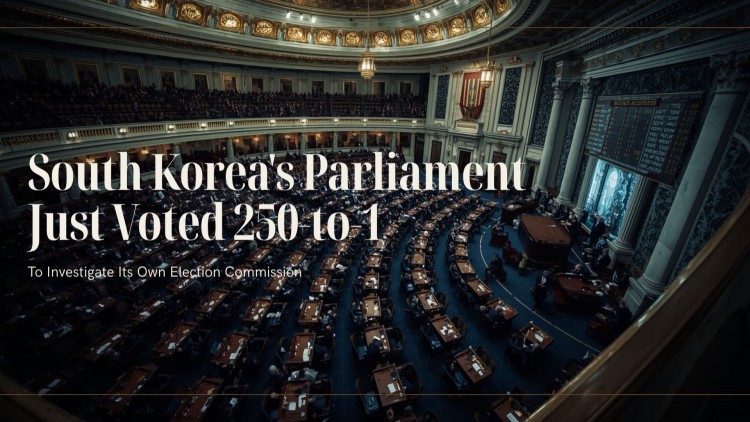
The vote was not close. On Thursday, 250 of 251 lawmakers present in the South Korean National Assembly voted to launch a parliamentary probe into the National Election Commission's handling of the June 3 ballot shortage - the closest thing to unanimous the deeply divided legislature has managed in months. The 18-member special committee, chaired by People Power Party lawmaker Yoon Sang-hyun, has 45 days to complete its work. The criminal investigation by a joint police-prosecutor team runs in parallel and has already begun calling in election workers for questioning.
What changed between last week and this week is the accumulation of secondary scandals around the NEC's former chairman - details that transformed an administrative failure story into something harder to contain.
The Chairman's Travel Budget
Documents submitted by the NEC to Democratic Party Rep. Yang Bu-nam revealed that former NEC Chairman Rho Tae-ak traveled with his spouse to Germany and Estonia in November 2024 under the banner of "exchange and cooperation with overseas election management bodies," at a reported cost of more than 70 million won (approximately $46,000), fully covered by the NEC's budget. A separate document set shows Rho again traveled with his spouse to Copenhagen and Stockholm the same month, at a reported cost of roughly 90 million won - also charged to the NEC.
The trips, totaling more than 160 million won in NEC funds, occurred less than two months before Yoon Suk-yeol's December 2024 martial law declaration - in which NEC headquarters was among the institutions that military forces were sent to secure. Rho, who at the time publicly called the deployment of troops to the NEC "inexcusably illegal," resigned as NEC chairman on June 6, three days after the ballot shortage. The travel expenditures were not public knowledge until this week.
Two Investigations, One Institution
The parliamentary committee and the criminal probe are now running simultaneously, targeting the same institution from different angles. The criminal investigation - ordered by President Lee Jae-myung on June 7 - is focused on whether NEC officials improperly influenced how many ballots were printed and how the commission responded to shortages on Election Day. The parliamentary probe, which both the ruling Democratic Party and the opposition People Power Party supported, is focused on institutional accountability and structural reform.
That bipartisan agreement is notable given the political stakes. Lee's Democratic Party won most June 3 local races. The PPP suffered further losses after its already weakened position following Yoon's impeachment. Both parties have reasons to want the NEC's credibility stabilized - the ruling party because a delegitimized election outcome is a political liability, the opposition because a weakened NEC creates long-term institutional vulnerability regardless of who holds power.
PPP chair Jang Dong-hyeok has pushed beyond the parliamentary probe to call for a special counsel investigation - an independent prosecutor free from the executive branch's oversight structure. That demand goes directly to the structural tension at the center of this story: the joint police-prosecutor team investigating the NEC reports ultimately to institutions under the Lee administration, the same administration that benefited from the June 3 results. The Democratic Party, which holds a parliamentary majority, has not yet committed to the special counsel. The 45-day committee timeline will determine whether that pressure holds.
What the Probe Can and Cannot Settle
The special committee's mandate covers the facts of the shortage, the NEC's crisis response, and legislative reforms to prevent recurrence. It cannot settle the question that the criminal investigation is focused on: whether the shortage was an administrative failure or something the law treats as a crime.
The distinction matters for how the protests are resolved. Demonstrations outside the SK Olympic Handball Gymnasium in Jamsil - the ballot counting site that protesters blockaded for 35 hours starting June 5 - have continued for two weeks, declining from 20,000 at their weekend peak to roughly 200 on weekday mornings. The NEC has maintained that the shortages do not meet the legal threshold for a rerun under existing election law, a position no court has overturned.
South Korea's Constitutional Court took four months to rule on Yoon's impeachment after the December 2024 martial law declaration. A criminal investigation of the NEC is a different process with different timelines. The parliamentary probe has 45 days. The protests have no fixed end date. And the NEC's successor leadership - the commission operates without a permanent chairman following Rho's resignation - has to administer whatever election or by-election comes next under conditions of near-total institutional mistrust.
The 250-to-1 vote is a consensus on the problem. It is not a consensus on the solution.


